Abstract:A news sentiment tool can hand you a tone score within seconds, but speed says nothing about accuracy. This explainer walks through how the score is assembled, why entity linking and aggregation windows can distort it, and why a fast alert often comments on the past rather than forecasting the next move.

A headline appears and a small badge turns red a second later. It is tempting to read that speed as insight, as if the software understood the news faster than any person could. What it usually did was score one sentence quickly. Scoring a sentence and understanding a market are two different jobs.
 Contents
What a real-time news sentiment tool actually measures
A real-time news sentiment tool is software that reads a stream of news text, gives each item a tone score, and pushes the result out within seconds. Tone here means the positive, negative, or neutral lean of the wording. The tool summarises language; it does not tell you the direction of a price, and it does not measure what a currency is worth.
The category has no single inventor to credit. It grew where text analytics, the automated sorting of language, met financial news feeds that computers can process. Its purpose is compression: turning hundreds of items into one number a person can glance at.
That purpose sets the first boundary. A sentiment score is a statement about words, not a claim about what happens next. A high reading can sit beside a falling price, and a low reading beside a rising one.
The building blocks: text, time, and score
Most tools are assembled from the same few parts. Naming them makes it easier to see where a fast alert can drift away from the story it claims to describe.
- Headline stream: a continuous feed of text from wire services, meaning news agencies that supply copy to many outlets, plus newspapers and official releases.
- Timestamp: the publication time recorded by the source, plus the processing time recorded by the tool. The gap between the two is latency, the delay before you see anything.
- Entity linking: deciding which instrument a story refers to, so a report about a finance ministry gets attached to that country's currency.
- Tone score: a label or number for each item, usually positive, negative, or neutral.
- Aggregation window: the period, often a few minutes, over which individual scores are combined into one figure.
Two of these parts deserve more attention than they usually receive. Entity linking and the aggregation window decide most of what the final number means, while the tone score absorbs most of the discussion. A tool that links a story to the wrong currency, or blends ten quiet minutes with one loud one, produces a tidy number with a messy past.
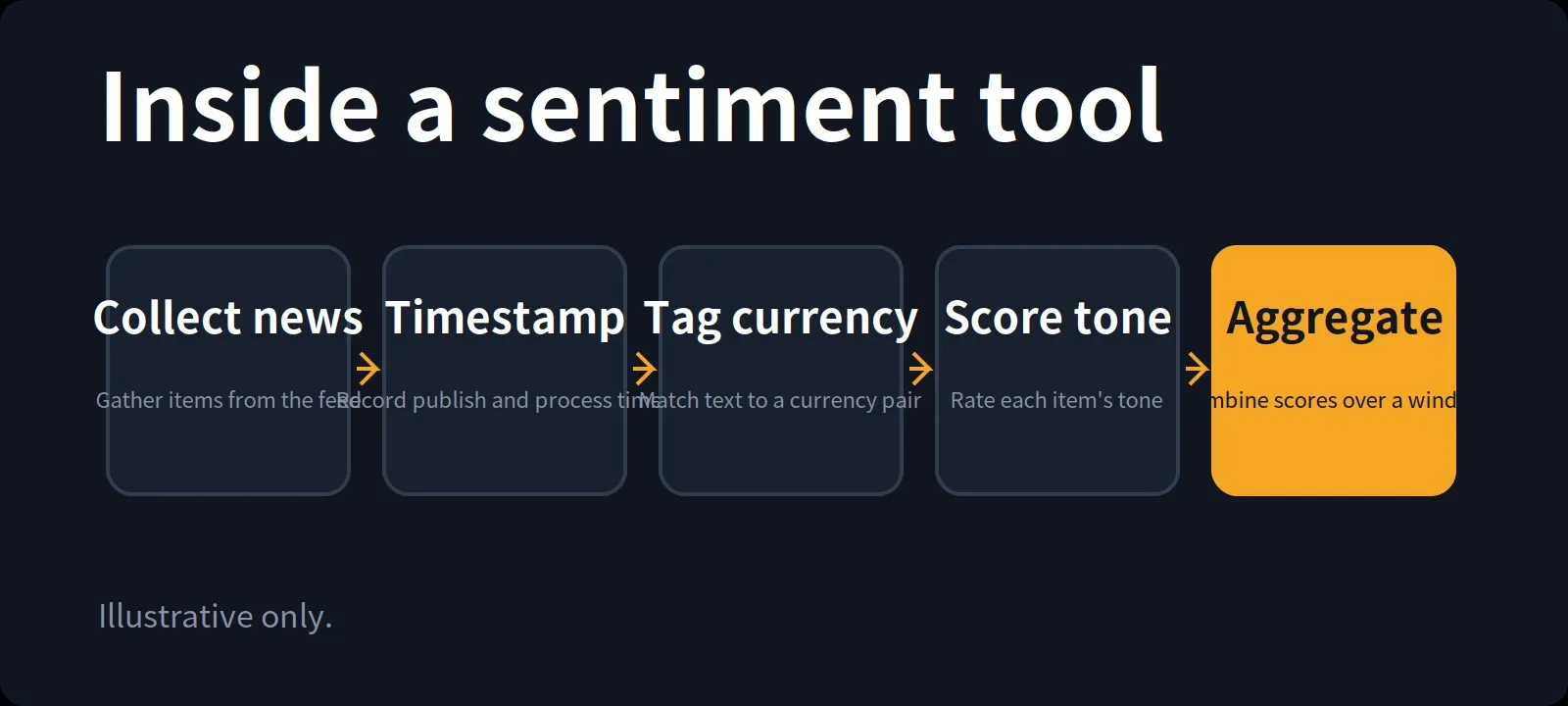
A simplified view of how raw text becomes a score.
How a sentiment score is built, step by step
A simple version of the calculation reads: net score equals positive items minus negative items, divided by the total number of items scored. It appears here only to demonstrate the mechanics, not as a model to trade with.
- Collect every item published inside a fixed window, for example ten minutes.
- Give each item one label: positive, negative, or neutral.
- Count how many items carry each label.
- Subtract the negative count from the positive count.
- Divide by the total number of items, so windows of different sizes can be compared.
This version includes neutral items in the total. Some tools exclude them, so the definition matters as much as the number.
Suppose, purely as a teaching example, that a hypothetical feed covering EUR/USD, meaning the euro against the US dollar, produces 60 items in a ten-minute window. Of those, 21 are scored positive, 15 negative, and 24 neutral. The net score is (21 - 15) / 60 = +0.10, a mildly positive reading. Nothing in that arithmetic is a forecast; the counts exist only to show the method.
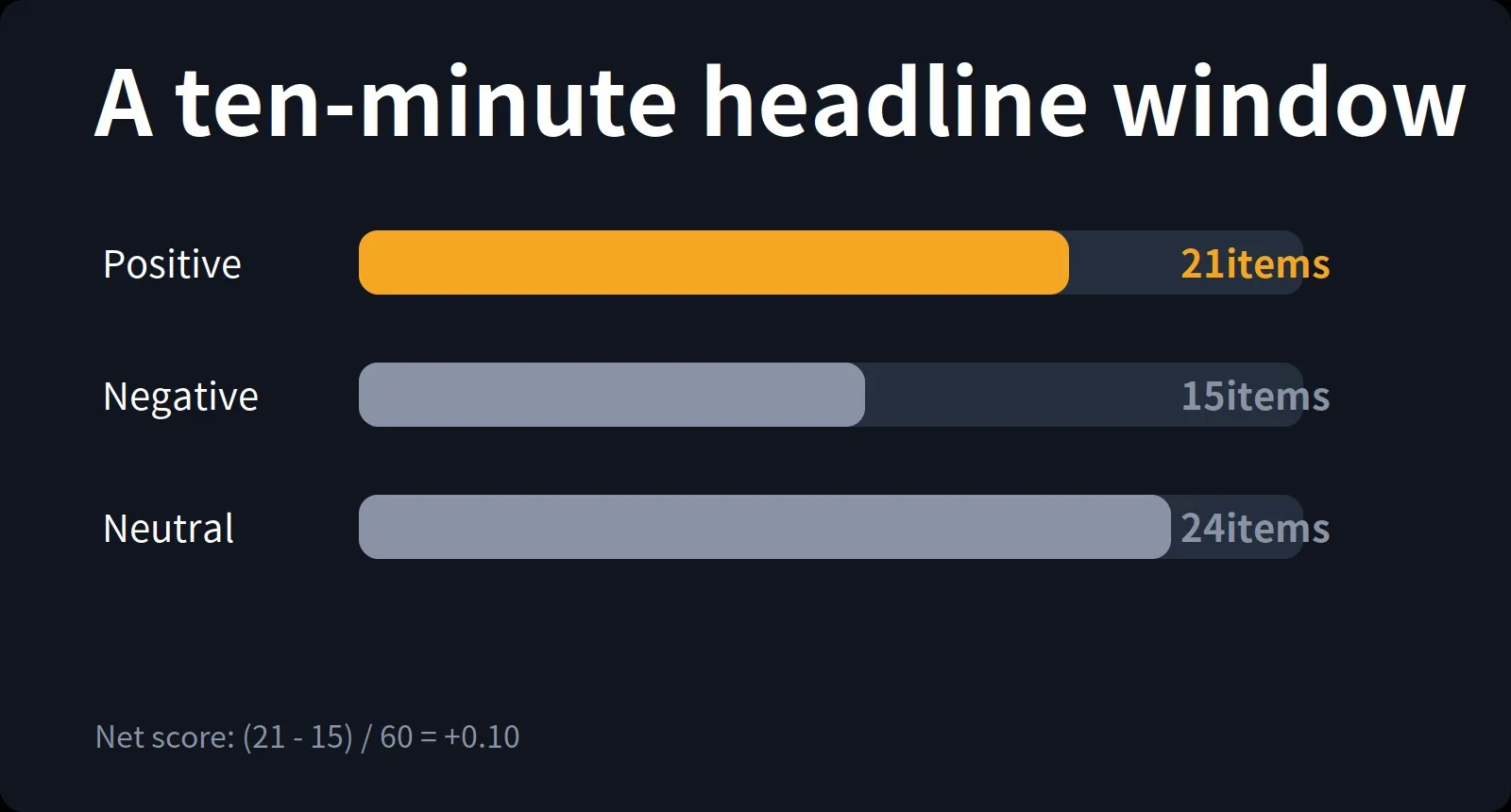
Hypothetical counts, used only to show the arithmetic.
A single item inside the same window can still trigger a flashing alert, for instance a short quote from an official that the tool scores strongly. That alert feels much larger than +0.10 because it is a different object: one sentence dressed in the authority of a number.
Tools also use different scales. Some report from -1 to +1, others from 0 to 100, and a 62 on one tool says nothing about a 62 on another. Comparing two screens without checking their scales is one of the easiest mistakes to make.
Where speed turns into misreading
Fast delivery magnifies a handful of specific weaknesses. Most of them sit in language and counting rather than in the arithmetic itself.
- Negation: the phrase 'no plan to raise rates' contains words a keyword system associates with tightening, yet read as a whole it says the opposite.
- Duplication: one wire story picked up by five outlets becomes five items, and the window counts every copy.
- Stale text: an old interview republished without a clear date receives a fresh timestamp and looks like new information.
- Ambiguous subjects: a comment that a currency is stable can be reassurance or complaint, and a score cannot separate the two.
- Thin coverage: feeds are dense for major currencies and sparse for many African currencies, so a local story may be missing entirely, or may arrive through translation that flattens its tone.
- Timing: by the time an alert lands, the headline it describes has often already been read by the market.
There is a psychological layer too. An alert that arrives quickly and carries a number feels more authoritative than a paragraph that has to be interpreted, and that feeling is easily mistaken for evidence. Speed creates a sense of being early, even when the underlying text is old.
A useful habit before reading anything into a score is to check four things: the timestamp, the entity tag showing which currency the story was linked to, whether the same story appears more than once, and the length of the window. Those checks take less time than the alert took to arrive.
So what is this tool, and what is it not? It is a fast summary of the tone of text. It is not a test of whether a story is true, a measure of how important it is, or a forecast of where a price goes next, and a high score is not a signal to act on.
Used with care, it can tell you that a large amount of coverage has appeared and roughly what mood that coverage carries. That is a modest piece of information, and it is worth having. The number may arrive within a second or two. The meaning still has to be read.
Finally, WikiFX would like to remind everyone that before using any US stock, futures, or forex brokers, remember to check the platform's regulatory information, trading environment, field inspection reports, user reviews, and overall rating on the WikiFX App. This will help you effectively avoid problematic scam platforms and rogue brokers, safeguarding your capital.