

Global Broker Regulation Inquiry App
About WikiFX
English
简体中文
繁體中文
English
Pусский
日本語
ภาษาไทย
Tiếng Việt
Bahasa Indonesia
Español
हिन्दी
Filippiiniläinen
Français
Deutsch
Português
Türkçe
한국어
العربية
اردو


Accused of a RM123 Million Crypto Scam, He Fled to Malaysia and Claimed He Was Robbed

WikiFX
|


Abstract:A 38 year old Chinese national, identified only by his surname Li, is alleged to have orchestrated a cryptocurrency investment scam that defrauded investors in China of more than US$30 million (approximately RM123 million). After reportedly fleeing to Malaysia, he later approached local authorities claiming that he had himself become the victim of robbery and assault.
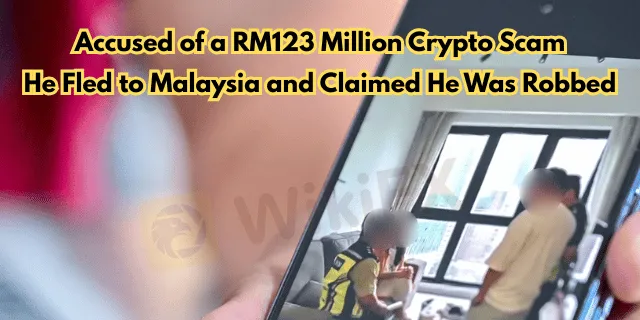
A 38 year old Chinese national, identified only by his surname Li, is alleged to have orchestrated a cryptocurrency investment scam that defrauded investors in China of more than US$30 million (approximately RM123 million). After reportedly fleeing to Malaysia, he later approached local authorities claiming that he had himself become the victim of robbery and assault.
 Contents
Alleged Scam Victims Tracked Him to Malaysia
According to World Humanitarian Commission Organisation (WHCO) chairman Datuk Paduka Seri Lai, Li sought assistance on 15 July, claiming that four Chinese nationals had robbed him of a waist pouch containing his passport, bank cards and RM40,000 in cash.
Lai subsequently accompanied Li to a meeting at a condominium in Kuala Lumpur, where five Chinese nationals had gathered in an attempt to resolve the dispute.
However, the meeting reportedly took an unexpected turn.
Instead of acknowledging Li as the victim, the five individuals accused him of being the mastermind behind a large scale cryptocurrency investment fraud that had allegedly operated in China since 2022.
They claimed to be representatives of victims who had travelled to Malaysia specifically to recover losses linked to the scheme.
Dispute Over Alleged Robbery
The representatives denied robbing Li.
According to Lai, they explained that the missing waist pouch had not been stolen but was inadvertently left behind after Li walked out during discussions.
Following the meeting, both parties lodged police reports.
Police subsequently informed them that the five Chinese nationals had already filed a report against Li on 7 July, alleging his involvement in the cryptocurrency investment scam.
A second round of discussions was arranged the following day.
However, Li reportedly left the meeting once again and has not been contacted since.
Based on the available information, Lai said he believes Li should not be regarded as a victim but as the alleged organiser of the investment fraud.
Suspected Fugitive
Lai further claimed that his own inquiries suggested Li was wanted by authorities in China over the alleged fraud.
He believes Li first fled to Thailand before later entering Malaysia, although the exact timing of his arrival has yet to be established.
According to Lai, Li appeared visibly uneasy after learning that the Chinese Embassy in Malaysia could potentially become involved in the matter. He also allegedly declined to provide contact details, citing language barriers.
His whereabouts remain unknown.
Fresh Allegations Raise Further Questions
The case became even more complicated when Li reportedly filed another police report on 31 July.
This time, he alleged that the same group of five Chinese nationals had threatened him with knives, assaulted him and forced him to transfer 2.9 million USDT, valued at approximately RM11.8 million, into two cryptocurrency wallets.
However, Lai questioned the credibility of those claims, stating that Li had been unable to provide medical reports or other supporting evidence to substantiate the alleged assault or extortion.
He believes the report may have been filed in an attempt to recover Li's passport, which had been seized by police, potentially enabling him to leave Malaysia.
The allegations have not been independently verified, and Malaysian police have not confirmed whether any offence was committed.
Malaysia's Growing Role in Cross Border Fraud Cases
According to Lai, the five Chinese representatives had travelled to Malaysia as early as last year in an effort to trace Li's whereabouts and had already submitted evidence to local authorities.
He also urged Malaysian authorities to remain vigilant against the increasing use of the country as a transit point or operational base for international fraud syndicates.
The case reflects a broader trend observed across Southeast Asia, where cryptocurrency related investment scams increasingly involve multiple jurisdictions, making investigations more complex and asset recovery significantly more challenging.
What Investors Can Learn
For forex and cryptocurrency traders, the case serves as another reminder that digital assets remain a preferred tool for organised investment fraud.
Cryptocurrencies such as USDT are widely used because transactions can be completed quickly across borders. While blockchain transactions are traceable, recovering stolen digital assets often requires cooperation between multiple law enforcement agencies, exchanges and regulators, particularly when funds move through different countries.
The alleged use of cryptocurrency in this case also reinforces the importance of conducting thorough due diligence before transferring funds to any investment platform or individual.
Legitimate investment firms operate under recognised regulatory frameworks, maintain transparent payment channels and do not rely on informal cryptocurrency transfers or personal accounts to accept client funds.
As Malaysian authorities continue investigating the case, it serves as another example of how investment fraud has evolved into a global challenge. For investors, the strongest protection remains careful verification, regulatory due diligence and a healthy level of scepticism whenever promised returns appear too good to be true.

Disclaimer:
The views in this article only represent the author's personal views, and do not constitute investment advice on this platform. This platform does not guarantee the accuracy, completeness and timeliness of the information in the article, and will not be liable for any loss caused by the use of or reliance on the information in the article.
WikiFX Broker
Latest News
11.09.26 Daily Forecast
WikiFXEURUSD | Demand Zone Holding, Bulls Eyeing Higher Resistance
WikiFXCMC Markets Extends US Share Trading Into Overnight Session
WikiFXUnited States Dollar Index holds onto gains above 99 ahead of US CPI data
WikiFXProp Firm FTMO to Acquire OANDA with $422 Million
WikiFXUK Chancellor Healey: Economy demonstrates welcome resilience despite global uncertainty
WikiFXEUR/USD: Bearish Structure Shift
WikiFXSilver Forecast: XAG/USD rebound capped as bearish bias holds
WikiFXKudotrade Review 2026: Reported Slippage & Trade Execution Issues You Should Know
WikiFXRBI's Record $136-Billion NRI Deposit Campaign: Closed Early, Windfall and Risks for Traders
WikiFX