Abstract:As markets fluctuation in uncertain times and headlines grow darker, investors are left asking a crucial question: Is this a temporary downturn or something far worse? The terms bear market, recession, and depression are often thrown around interchangeably, but they represent very different levels of economic pain. Read this article to understand the differences between all three.

As markets fluctuation in uncertain times and headlines grow darker, investors are left asking a crucial question: Is this a temporary downturn or something far worse? The terms bear market, recession, and depression are often thrown around interchangeably, but they represent very different levels of economic pain. Read this article to understand the differences between all three.
A bear market is defined by a decline of 20% or more from recent highs in major stock indices. Its usually sparked by shaken confidence: concerns over interest rates, corporate earnings, or geopolitical risks. While unsettling, bear markets are often short-lived compared to broader economic downturns.
Retail traders should view bear markets as a stress test for strategy. This is not the time for panic-selling. Instead, reassess your risk tolerance, rebalance portfolios, and consider accumulating strong assets that may be temporarily undervalued.
A recession cuts deeper. It involves a sustained slowdown in economic activity, typically marked by two consecutive quarters of negative GDP growth. During recessions, we see rising unemployment, consumer retrenchment, and slumping business confidence. The damage extends beyond markets – it affects everyday life.
In this phase, central banks often respond with stimulus, but recovery can be uneven. Traders may benefit by shifting towards defensive sectors like healthcare, consumer staples, or utilities, and staying alert to monetary policy changes that affect interest rate-sensitive assets.
A depression is not just a deeper recession – it's a prolonged economic collapse. The most infamous example, the Great Depression of the 1930s, lasted nearly a decade and redefined global finance. Severe contractions in output, extreme unemployment, and widespread bankruptcies define this grim reality.
While modern safeguards have made depressions less likely, they are not impossible. For investors, the focus must shift from profit to preservation: high cash reserves, minimal leverage, and ultra-conservative asset choices. It's about surviving first, thriving later.
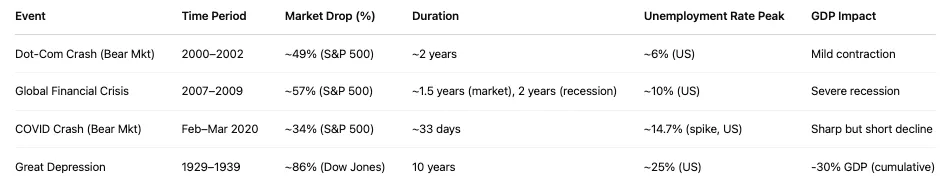
Historical Comparison of Bear Markets, Recessions, and Depressions
The real truth is, no can guarantee what happens next in the market. By the time it‘s clear whether we’re in a bear market, a recession, or worse, it may be too late to act. Thats why preparation is more essential than prediction.
To stay resilient in times of uncertainty, retail investors should adopt a disciplined and strategic approach. Diversification is key because not all assets react the same way to market shocks, spreading exposure across different sectors and global markets can help cushion losses. Maintaining liquidity is equally important; having enough cash on hand allows investors to take advantage of sudden opportunities or weather financial setbacks. Employing stop-loss strategies with care can also protect capital when emotions run high and markets turn volatile. Rather than reacting to headlines, investors should pay close attention to hard data such as unemployment figures, inflation rates, and central bank policy updates which often provide clearer signals of economic direction. Above all, maintaining a long-term perspective is crucial: while short-term downturns can be painful, they often present the foundation for future growth when navigated wisely.