Abstract:Is slay4x Considered a Safe Broker or Suspected of Being a Scam in Q4 2026? Read our detailed analysis on withdrawal delays, regulatory risks, and South Asian trader reviews.
 SLAY4X Forex Broker Under Fire Withdrawal Trap or Safe Haven in Q4 2026.jpg" title="SLAY4X Forex Broker Under Fire Withdrawal Trap or Safe Haven in Q4 2026.jpg">
 Contents
The Looming Shadow Over SLAY4X: A Q4 2026 Financial Reality Check
The retail foreign exchange trading landscape across South Asia—spanning India, Pakistan, Bangladesh, and neighboring financial centers—has witnessed explosive participation throughout 2026. However, increased market volume has also brought heightened scrutiny regarding capital preservation and broker reliability.
As fourth-quarter market volatility peaks, a growing number of retail traders are raising serious concerns over SLAY4X Markets Limited (commonly known as SLAY4X).
What initially began as scattered complaints in trader forums has rapidly transformed into a structured wave of exposure reports on financial monitoring platforms, including WikiFX.
At the epicenter of this controversy is a recurring, distressing theme: traders across the subcontinent reporting severe obstacles, unfulfilled requests, and outright account lockouts when attempting to withdraw their hard-earned profits.
Is SLAY4X operating as a legitimate offshore brokerage experiencing technical bottlenecks, or are traders witnessing the systemic red flags of an unsafe entity?
Chronology of Client Grievances: Approved Statuses, Unpaid Funds, and Locked Portfolios
To understand the scope of trader frustration surrounding SLAY4X, one must examine the specific mechanics of the reported withdrawal failures. A synthesis of exposure submissions and user complaints reveals a distinct, repeating pattern of operational anomalies:
1) The “Approved” Dashboard Illusion:
Multiple traders report submitting withdrawal requests via the internal client portal. Within hours or days, the system status updates to “Approved” or “Completed”. However, the funds fail to materialize in bank accounts, local payment gateways, or crypto wallets—even after standard processing windows elapse.
2) Abrupt Terms & Conditions Enforcement:
When traders press customer support for explanations regarding missing transfers, several report receiving standardized notifications claiming their accounts are undergoing “audit reviews” for “abnormal trading strategies” or “leverage exploitation.” In numerous instances, accumulated trading profits were retroactively wiped from account balances without transparent trade log audits.
3) Communication Blackouts:
Initial inquiries submitted through live chat or ticket systems are often met with automated bot responses. As withdrawal escalations persist, client accounts are frequently subjected to restricted portal access or total MT4/MT5 platform disconnections, leaving traders stranded without recourse.
Regulatory Oversight under Scrutiny: Offshore Licenses vs. Regional Investor Safety
A pivotal factor in evaluating any brokerage is its regulatory footprint. Traders operating within South Asian jurisdictions must carefully analyze the legal protections—or lack thereof—governing SLAY4X Markets Limited.
- Offshore Registration Reality:
SLAY4X primarily operates under offshore business registrations and secondary jurisdictional filings. While offshore jurisdictions permit corporate formation and basic business operation, regulatory authorities in these regions typically do not enforce strict capital adequacy rules, mandatory investor compensation funds (ICF), or negative balance protection.
- Absence of Tier-1 Safeguards:
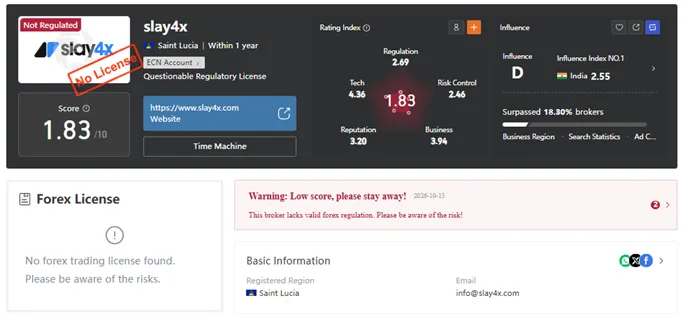
SLAY4X does not hold primary licenses from Tier-1 global regulators such as the Financial Conduct Authority (FCA - UK), the Australian Securities and Investments Commission (ASIC), or the Commodity Futures Trading Commission (CFTC - US). Furthermore, regulatory checking databases—including SEBI lists in India—confirm that the entity lacks local regulatory approval or recognized financial intermediary authorization to solicit or execute derivative trading within regional banking networks.
- Segregated Account Deficits:
Because the broker lacks authorization from regional monetary authorities, client deposits are not held in local custodian bank accounts monitored by government clearing corporations. This exposes deposited capital to operational commingling and severe liquidity risks.
Digital Footprint & Infrastructure Analysis: Redirection Networks and Hosting Patterns
Technical investigations into SLAY4X's web infrastructure yield additional parameters that warrant caution. Web routing traces indicate that the brokerage utilizes dynamic IP redirection networks and proxy hostings to direct traffic from South Asian jurisdictions.
While content delivery networks (CDNs) are routinely used by modern websites to optimize load speed, the deployment of obfuscated IP server routes alongside unannounced domain changes is a common tactic observed among high-risk financial platforms.
This setup makes digital footprint tracking, domain verification, and legal summons exceedingly difficult for retail investors facing contract disputes.
Risk Verification Checklist for South Asian Traders
Before depositing capital or continuing trading operations on SLAY4X Markets Limited, evaluate your risk exposure using the following criteria:
- [ ] Local Regulatory Verification: Is SLAY4X recognized or licensed by your country's central monetary authority (e.g., SEBI/RBI in India)? (Answer: No)
- [ ] Safety Index Rating: Does the broker maintain a high rating and verified physical site survey score on independent tracking platforms like WikiFX? (Answer: No, safety scores remain low with high-risk exposure flags)
- [ ] Withdrawal Record: Are there documented public reports of unresolved withdrawal delays or profit cancellations? (Answer: Yes, multiple user exposures report unresolved withdrawal issues)
- [ ] Dispute Mediation: Is there an independent financial ombudsman available to legally compel the broker to release withheld funds? (Answer: No, offshore registration provides no local legal enforcement mechanisms)
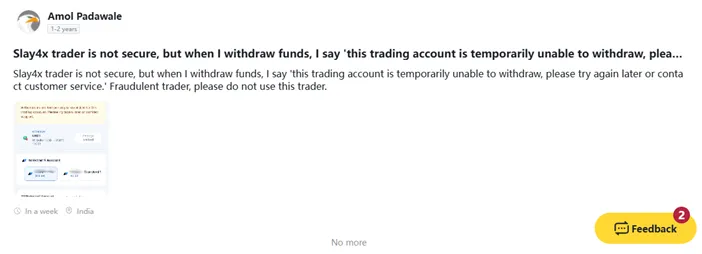
Settlement via WikiFX Exposure: A Path for Users from India to Recover Funds
Source: https://www.wikifx.com/en/exposure/detail/COG20261005150933438882641.html
Navigating unresolved withdrawal requests can be a daunting experience for retail investors operating under offshore brokerages. In a notable case involving SLAY4X, a user from India initially encountered severe operational delays when attempting to withdraw accumulated capital from the platform.
Despite fulfilling standard trading requirements and submitting valid account credentials, the transaction remained stalled in processing without clear technical or regulatory justifications provided by customer support.
Faced with a communication impasse and growing concerns over fund safety, the trader leveraged the WikiFX Exposure column—a public grievance platform dedicated to exposing broker misconduct and mediating disputes. By submitting comprehensive documentation, including account IDs, withdrawal receipts, and communication logs, the exposure brought much-needed public visibility to the issue.
Following the public broadcasting of the dispute on WikiFX, SLAY4X addressed the delayed payout and processed the long-overdue funds back to the trader, demonstrating the power of community exposure and third-party transparency in resolving cross-border financial disputes.
Is It Safe or a Scam? The Final Q4 2026 Judgment
Evaluating whether a broker is an outright scam or simply a high-risk entity requires objective differentiation. SLAY4X Markets Limited maintains active digital infrastructure and provides functional trading platform connectivity; thus, labeling it purely as a phantom website would be inaccurate.
However, judging by the critical parameters of investor safety, fund accessibility, and regulatory transparency, SLAY4X is classified as a VERY HIGH-RISK (HIGH RISK) brokerage in Q4 2026.
The combination of unresolved withdrawal complaints, lack of Tier-1 or local South Asian regulatory authorization, and reliance on offshore legal frameworks means that trading on this platform carries an extreme risk of capital loss.
Traders prioritising capital security should exercise extreme caution, avoid depositing new capital, and consider migrating trading portfolios to fully regulated, legally compliant brokerage institutions.
Frequently Asked Questions (FAQ)
Q1: Is SLAY4X Markets Limited legally registered and authorized to operate in India, Bangladesh, or Pakistan?
Answer: No. SLAY4X does not hold license authorizations or recognized intermediary status from regional regulators (such as SEBI in India or equivalent central monetary authorities in South Asia). It operates as an offshore broker without local legal oversight.
Q2: Why are traders experiencing withdrawal delays and account status issues on SLAY4X?
Answer: According to exposure reports submitted on WikiFX and trader forums, withdrawal requests frequently stall during processing or are marked as “Approved” without actual bank transfers. The broker often cites internal compliance reviews, abnormal trading clauses, or technical issues without providing transparent transaction logs.
Q3: What should I do if my withdrawal request is stuck or denied by SLAY4X?
Answer: Document all evidence immediately—take screenshots of your account balance, transaction history, dashboard withdrawal status, and customer service conversations. Since local financial authorities cannot intervene in offshore disputes, publishing a formal report with full documentation on independent platform forums like WikiFX Exposure can increase visibility and push the broker toward resolution.
Q4: Can offshore regulatory licenses protect my funds in case of a broker insolvency or dispute?
Answer: Offshore licenses generally provide minimal protection for international retail traders. They rarely offer investor compensation funds or cross-border legal mediation, meaning clients have virtually no guaranteed mechanism to recover funds if an offshore broker refuses payment or faces insolvency.