

Global Broker Regulation Inquiry App
About WikiFX
English
简体中文
繁體中文
English
Pусский
日本語
ภาษาไทย
Tiếng Việt
Bahasa Indonesia
Español
हिन्दी
Filippiiniläinen
Français
Deutsch
Português
Türkçe
한국어
العربية
اردو


Bill Gates Warns the World Is Not Ready for AI's Biggest Risks

WikiFX
|


Abstract:Bill Gates has warned that the world is entering the artificial intelligence era without a credible plan to manage its economic and social impact, with jobs, cybersecurity and human relationships among the areas facing growing risks.
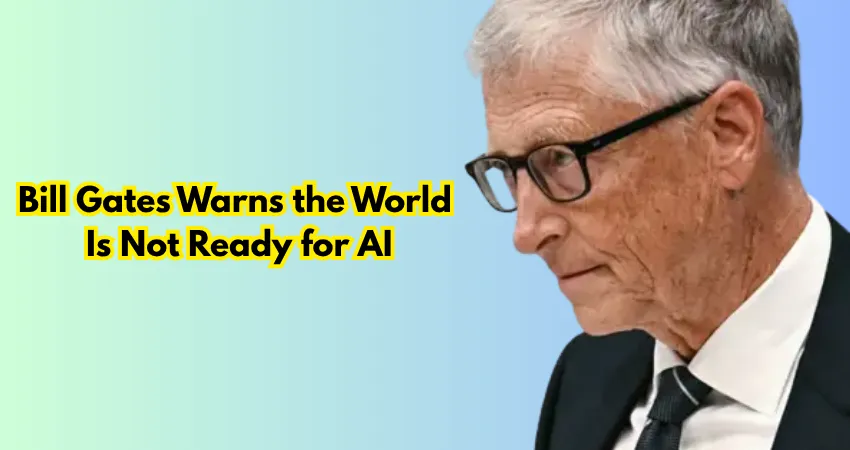
Bill Gates has warned that the world is entering the artificial intelligence era without a credible plan to manage its economic and social impact, with jobs, cybersecurity and human relationships among the areas facing growing risks.
In a nearly 6,000-word essay published on his blog on 26 August, the Microsoft co-founder said the rapid development of AI could become one of the most disruptive periods in modern history. He argued that governments and businesses are moving faster to develop the technology than to establish safeguards for its consequences.
Gates, 70, said AI could become a powerful force for reducing inequality but could also create new forms of economic injustice. He believes geopolitical competition and commercial incentives are pushing countries and technology companies to accelerate development despite the risks.
 Contents
Young workers face job losses
Gates identified permanent job destruction as his biggest concern. He rejected comparisons between AI and the historic move from agricultural work to office-based employment, saying the earlier transition took place over generations and created new jobs that still relied on human thinking.
AI could instead automate cognitive work itself, putting industries such as law, medicine, customer service, software development and manufacturing under pressure within about a decade.
Entry-level and mid-level positions could be particularly vulnerable, leaving younger workers with fewer opportunities to enter the labour market and gain experience.
Gates also expects advances in robotics to increase pressure on manual workers. Construction and hospitality could face greater disruption by the end of the decade. He suggested that some jobs may need to be reserved for humans even when AI can perform them more cheaply or efficiently.
AI could strengthen cybercriminals
Cybersecurity is another major concern. Gates said specialists were increasingly worried that attackers are gaining capabilities faster than defenders can identify and repair weaknesses.
The threat extends to critical services, including hospitals, banks, water systems and electricity networks. For financial markets, increasingly sophisticated AI-assisted attacks could create additional risks for banks, brokers and their customers.
Children and relationships at risk
Gates also raised concerns about AI's effect on children and social development.
He cited research suggesting that chatbots which constantly satisfy users and rarely challenge them could encourage dependency. For young people, excessive reliance on AI companions could reduce opportunities to develop communication and social skills through real-world relationships.
Human interaction often involves disagreement, frustration and compromise. Gates warned that AI systems designed to avoid these experiences could deprive users of important lessons in dealing with other people.
Gates remains invested in AI
Despite his concerns, Gates continues to have significant financial ties to the technology industry. He acknowledged that profits from his investments will ultimately support the Gates Foundation, which plans to spend about US$200 billion (RM805.4 billion) over the next two decades.
His warning therefore comes from someone with substantial exposure to the technology sector rather than an outright opponent of AI.
For investors, businesses and workers, Gates' assessment highlights a growing challenge: AI development is accelerating, but policies and safeguards may not be keeping pace with the technology's economic and social consequences.

Disclaimer:
The views in this article only represent the author's personal views, and do not constitute investment advice on this platform. This platform does not guarantee the accuracy, completeness and timeliness of the information in the article, and will not be liable for any loss caused by the use of or reliance on the information in the article.
WikiFX Broker
Latest News
ED Files Charge Sheet in Nexa Evergreen Investment Case Involving Rs 2,676 Crore
WikiFXScore Capital Markets Ltd 2026 Review: Gateway or Trap?
WikiFXFirst Light News: Chip Rout Rattles Equities as Q3 Earnings Season Kicks Off
WikiFXThe Dollar Surges as Gold Slides. Could a Turning Point Be Near?
WikiFXClient Saved via WikiFX Exposure ! Is slay4x Considered a Safe Broker or a Scam in Q4 2026?
WikiFXFirst Light News: Earnings & US CPI in Focus
WikiFXConsumer prices rose at 3.7% annual rate in September as gas costs skyrocket
WikiFXRetiree Loses RM118,000 Through Fake Stock Investment Website
WikiFXNPBFX Broker Review: Regulated but Is It Safe for Traders?
WikiFXBluVox Markets Ltd Review 2026: Safe Trading Haven or High-Risk Trap?
WikiFX