

Global Broker Regulation Inquiry App
About WikiFX
English
简体中文
繁體中文
English
Pусский
日本語
ภาษาไทย
Tiếng Việt
Bahasa Indonesia
Español
हिन्दी
Filippiiniläinen
Français
Deutsch
Português
Türkçe
한국어
العربية
اردو


Robinhood’s AI Trading Boom Raises a Bigger Question: Who Pays When AI Gets It Wrong?

WikiFX
|


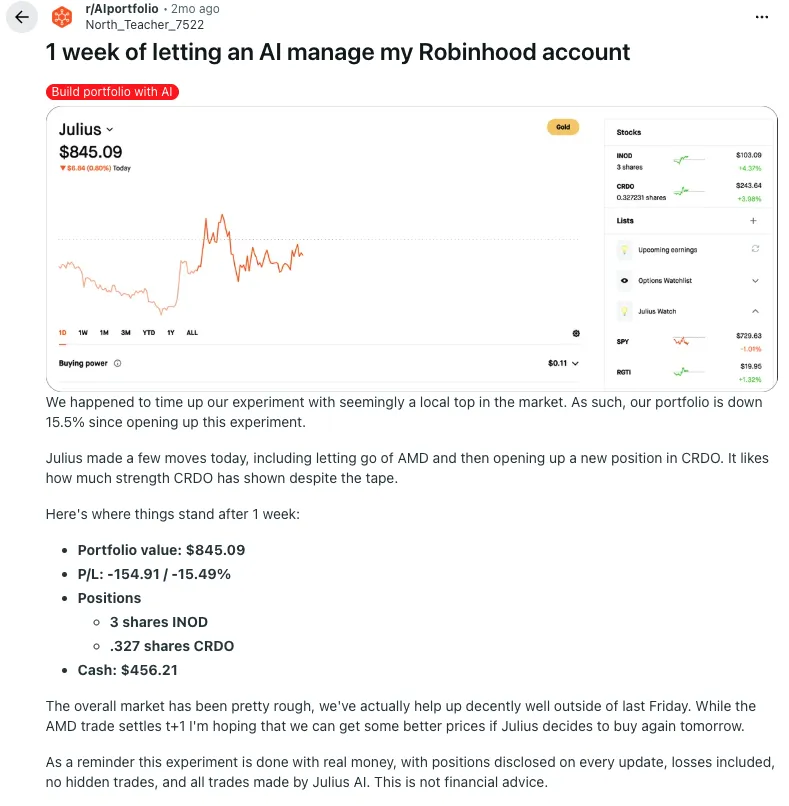
Abstract:Robinhood’s launch of its “AI agent accounts” in July has brought that question into sharp focus. The feature allows users to give AI based instructions that can then be used to execute stock and options trades. Within weeks, around 50,000 users reportedly opened such accounts, while daily AI driven trading activity reached several million US dollars. The excitement, however, was followed by scrutiny.
Robinhoods launch of its “AI agent accounts” in July has brought that question into sharp focus. The feature allows users to give AI based instructions that can then be used to execute stock and options trades. Within weeks, around 50,000 users reportedly opened such accounts, while daily AI driven trading activity reached several million US dollars.
The excitement, however, was followed by scrutiny.
Users examining Robinhoods agreement found language stating that customers are responsible for how their AI agents are built and for actions taken by those agents.
The issue is straightforward. If an AI agent misunderstands an instruction, takes a position that is much larger than expected or makes a series of damaging trades during a volatile market, the customer may ultimately bear the financial consequences.
Robinhood has pointed to several safeguards, including spending limits, restricted access to account funds, an option to disable the AI agent, fraud monitoring and human approval for certain actions. The system also allows users to review order details before execution.
Yet the responsibility clause has raised concerns because these safeguards do not necessarily change who carries the loss when an automated decision goes wrong.
For traders, particularly those using leverage or derivatives, the distinction could be significant. A mistake involving a conventional investment may result in a loss of capital. A poorly controlled automated strategy involving options or leveraged products could produce much larger losses in a very short period.
The rapid adoption has raised another concern: whether the financial system is becoming increasingly dependent on a relatively small number of AI technologies.
Industry executives have acknowledged that comprehensive rules governing AI agents in trading are still lacking. ThinkMarkets chief executive Nauman Anees has described the absence of established AI trading governance as a major challenge for the industry.
That regulatory gap could become more serious if large numbers of AI systems begin responding to the same market signals at almost the same time.
An AI system could identify a market move, while other systems using similar models respond to the same signal. If thousands of automated agents make similar decisions within milliseconds, the resulting buying or selling pressure could amplify market movements far faster than human traders could react.
This creates a risk that goes beyond individual accounts.
A market shock caused by human investors gradually moving in the same direction can develop over minutes or hours. Automated systems could potentially create similar behaviour almost instantaneously.
Regulators are aware of the issue, but the rules are still developing. The European Securities and Markets Authority issued guidance on AI and algorithmic trading in February, while the European Union's AI framework does not yet specifically classify AI agent trading as a high risk application. The UK's recent regulatory work has also yet to establish a dedicated framework for autonomous trading agents.
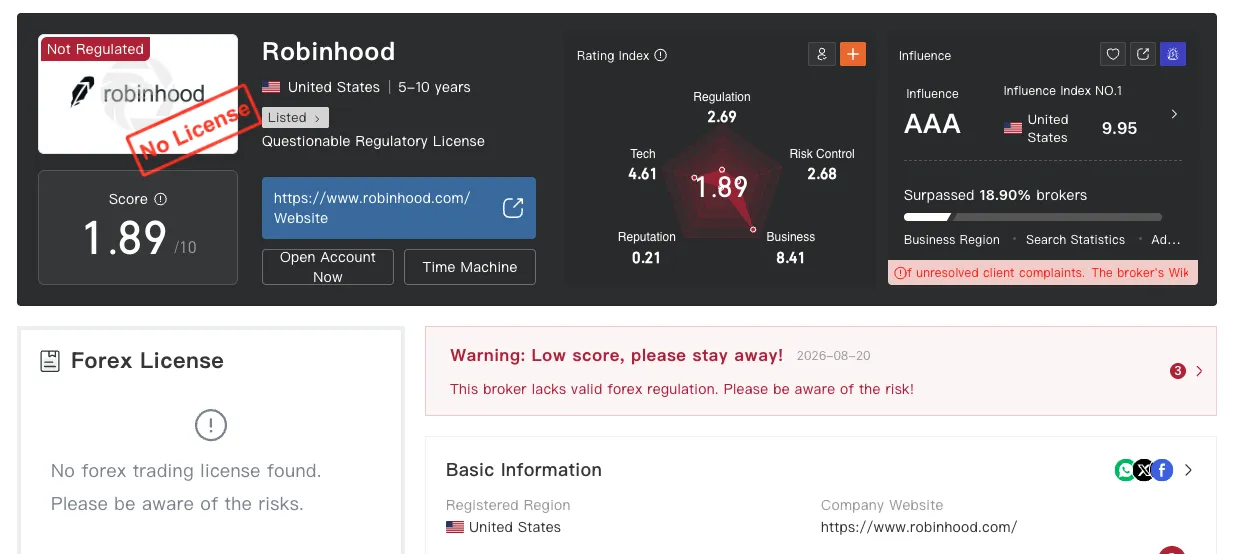
Another question is, when you are using the AI launched by an regulated platform like Robinhood, to what extent can you put the responsibility on the broker or even regulators.
View WikiFX's full review on Robinhood here: https://www.wikifx.com/en/dealer/4921572448.html
For Malaysian retail traders, the lesson is not that AI trading is inherently dangerous. The bigger issue is understanding where the risk sits before handing trading decisions to an automated system.
An AI agent may make trading faster and more convenient, but speed does not remove responsibility. If the broker's terms place losses from an agent's actions on the customer, traders need to understand that arrangement before enabling the technology.
This is particularly important for forex and CFD traders, where leverage can magnify both gains and losses.
The AI trading boom is still in its early stages. For now, brokers are racing to build the technology while regulators are working to determine how it should be governed.
That leaves retail traders facing a simple but critical question before pressing the “enable” button: if the AI makes the decision, but you take the loss, how much control do you really have?

Disclaimer:
The views in this article only represent the author's personal views, and do not constitute investment advice on this platform. This platform does not guarantee the accuracy, completeness and timeliness of the information in the article, and will not be liable for any loss caused by the use of or reliance on the information in the article.
WikiFX Broker
Latest News
RM12.47 Million in Cryptocurrency Vanishes From Malaysian Man’s Wallet
WikiFXCMC Markets Secures LSEG Data Deal to Accelerate Global Expansion
WikiFXUS Interest Rate Forecast: CPI to Test December Fed Hike Bets
WikiFXIndian Police Arrest Two in Alleged ₹10 Crore Crypto Investment Fraud
WikiFXUS Dollar Price Forecast: DXY Eyes 102.49, Can EUR/USD Hold 1.1180 Ahead of CPI?
WikiFXFirst Light News: US CPI, Aussie Jobs and Bank Earnings in Focus
WikiFXIndias retail inflation jumps to 5.54% in September, above estimates
WikiFXFOREX.com Review 2026: Deposit & Withdrawal Issues Persist, Traders Claim
WikiFXdbinvesting Broker Exposed: What Are Other Traders Saying About This Broker?
WikiFXRBI Opens a Daily Dollar Window for Indian Oil, HPCL and BPCL — and Rewrites the Hedging Rules
WikiFX