World Cup Fever Is Here! Choose your broker like you choose your team
Join WikiFX and investors worldwide in celebrating the excitement of the 2026 FIFA World Cup!
简体中文
繁體中文
English
Pусский
日本語
ภาษาไทย
Tiếng Việt
Bahasa Indonesia
Español
हिन्दी
Filippiiniläinen
Français
Deutsch
Português
Türkçe
한국어
العربية
اردو
Abstract:Oil markets tumbled on renewed geopolitical signals and market anxieties as both Brent crude and West Texas Intermediate (WTI) futures plunged over 5% following a fragile cease-fire agreement between Iran and Israel and a surprising comment from the U.S. President regarding Chinese imports of Iranian oil.
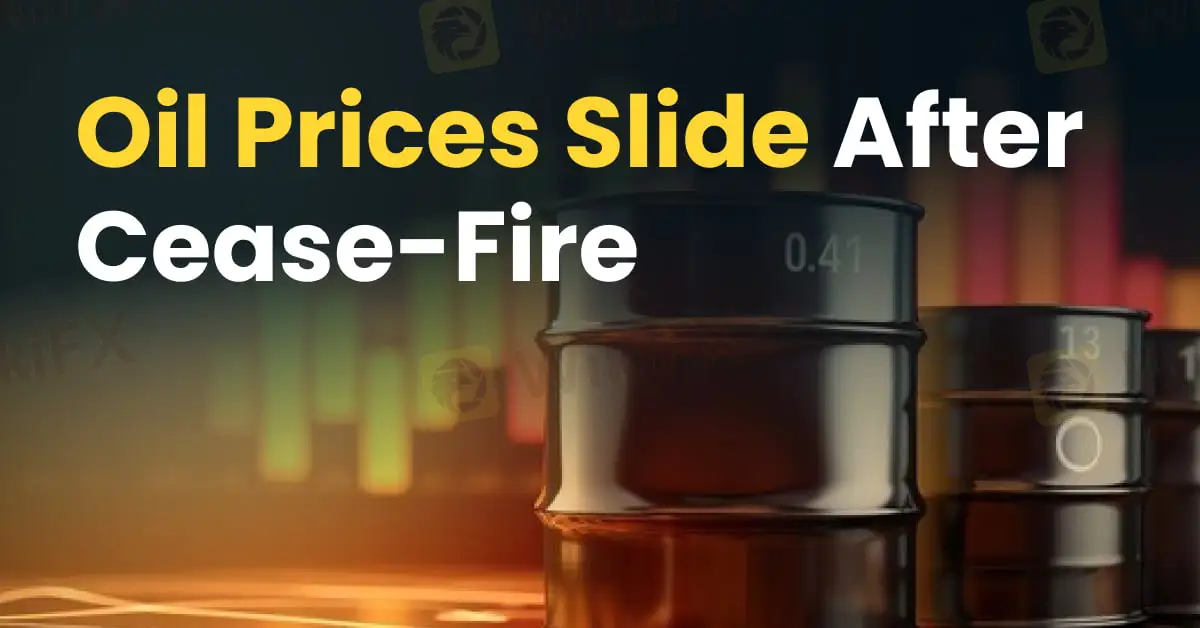
Oil markets tumbled on renewed geopolitical signals and market anxieties as both Brent crude and West Texas Intermediate (WTI) futures plunged over 5% following a fragile cease-fire agreement between Iran and Israel and a surprising comment from the U.S. President regarding Chinese imports of Iranian oil.
On social media, the U.S. President remarked that China is allowed to purchase oil from Iran, despite the United States having imposed numerous sanctions over the years to curtail such activity. The statement was unexpected and raised questions about the future enforcement of U.S. sanctions under Washingtons “maximum pressure” campaign against Tehran.
Oil prices reacted sharply. By the close of trading:
These losses extend an earlier decline triggered by the announcement of a fragile cease-fire between Iran and Israel, easing concerns about immediate supply disruptions in the Middle East.
Implications for the Oil Market
The sudden drop in oil prices underscores how geopolitical developments — particularly those involving major oil-producing nations like Iran — can quickly change sentiment. While a cease-fire might ease fears of supply disruptions, any suggestion of increased Iranian supply due to a loosening of sanctions can put significant downward pressure on prices.
Market participants will now be watching:
Conclusion
The combined effect of a cease-fire in a volatile region and an ambiguous message on sanctions has jolted the oil market, leading to one of the steepest single-day declines in recent months. As uncertainty lingers, traders are likely to remain cautious, waiting for more clarity on both diplomatic developments and oil supply outlooks.


Disclaimer:
The views in this article only represent the author's personal views, and do not constitute investment advice on this platform. This platform does not guarantee the accuracy, completeness and timeliness of the information in the article, and will not be liable for any loss caused by the use of or reliance on the information in the article.

Join WikiFX and investors worldwide in celebrating the excitement of the 2026 FIFA World Cup!

Some broker comparisons end with a confident "go with this one." This is not one of them — and that honesty is exactly what makes it worth reading. Wundersys and tradgrip are two young, offshore-registered brokers that keep popping up in front of beginner traders, often through aggressive online marketing. Both promise the usual buffet: tight spreads, generous leverage, multiple account tiers. And both, according to WikiFX, sit near the very bottom of the safety scale. So instead of crowning a champion, this comparison is really about something more useful: learning to read the warning signs, understanding the small differences that still matter, and knowing why "the better of two risky options" is still a conversation about risk.

If you trade forex from India, Pakistan, Bangladesh, Sri Lanka, or Nepal, you already know the quiet truth that eats into every trader's results: it is not just the market that decides whether you profit — it is the cost of getting in and out of each trade. Shave a couple of dollars off your commission on every lot, multiply it across hundreds of trades a year, and you are looking at the difference between a strategy that works and one that bleeds out slowly. South Asian traders are some of the most cost-conscious in the world, and rightly so. So we pulled the data on the brokers most often recommended for the region, cross-checked every name on WikiFX, and ranked them by the one number that matters most here: what they actually charge you to trade. Before the list, one quick lesson that will make this whole ranking click.

If you have spent even a week inside trading communities lately, you already know the pitch by heart. Pass a quick "challenge," get handed a funded account worth tens of thousands of dollars, and keep up to 80% of everything you make. No risking your own savings, no slow grind of building capital from scratch — just skill, a small fee, and a fast track to the big leagues. It is the exact dream every new trader is secretly chasing, and an entire industry has sprung up to sell it. XPO Fund is one of the louder voices selling that story right now. Its website is slick, its plans sound generous, and its marketing leans hard on words like "industry's lowest fee" and "fast payouts." But before you reach for your card, there is one number sitting quietly on this firm's profile — a number it would rather you scroll past — that every experienced trader would beg you to look at first. And no, it is not the profit split. Let's pull XPO Fund apart piece by piece: what it actually is, who is real