Abstract:Foreign exchange brokerage Admirals is merging its Estonian unit, Admirals Markets AS, with its parent group, and plans to relinquish its Estonian investment company license by August 2023. Admirals aims to broaden its global presence while retaining Estonia as a strategic hub. Residual bond-related duties will be transitioned to Admirals Group.
Renowned foreign exchange brokerage entity, Admirals, previously known as Admiral Markets, has publicized its strategic decision to consolidate operations with its Estonian arm, Admirals Markets AS. The projected finalization of this business unit is earmarked for the initial half of 2024.
In keeping with this initiative, the firm seeks to renounce the investment company license held by its subsidiary in Estonia, with the intent of doing so by August 2023. According to Admirals, the choice to overhaul the organizational structure stems from an essential requirement and deliberate resolution to broaden its worldwide footprint.
“Admirals Group AS is gearing up for a major restructuring of the group this year, whereby Admirals Markets AS will be amalgamated with Admirals Group AS. Consequently, Admirals Markets AS is set to surrender the investment company license it possesses in Estonia,” the press release clarified.
Admirals Group AS currently has a tangible presence in 18 nations through its affiliate companies, serving a clientele base spanning over 145 countries.
Even with the unfolding restructuring, Estonia will continue to be a paramount strategic pivot for the Admirals Group. The firm reasserts its allegiance to the nation by retaining its main operational hub in Tallinn, employing in excess of 100 specialists. Furthermore, the groups lending platform, MoneyZen, will persist under the regulation of Estonia's financial governing body.
As a ramification of these advancements, any residual rights and obligations linked with bonds that have not been bought back by Admiral under the existing offer will be transitioned to Admirals Group AS. Admirals Group AS will accept the duty of managing these bonds as per the bond terms till their due date. This ensures that the interests of the bondholders will persistently be respected and fulfilled during the merger transition.
Earlier in the month, Admirals inaugurated a fresh office in Nigeria as a segment of its expansion strategy to fortify its standing as a significant financial services contributor in Africa. This achievement occurs less than twelve months post the receipt of regulatory endorsement for Admirals SA (PTY) Ltd, an operational offshoot of Admirals, to facilitate CFDs trading to investors in South Africa.
The newly formed entity is located in Cape Town. Functioning as an execution dealer, Admirals SA (PTY) Ltd proffers both CFDs and stock trading and is already laying the groundwork to introduce further products under this South African license in the future. However, the brokerage is proscribed from extending investment advice or propositions pertaining to CFDs transactions.
The Estonia-originated firm, which commemorated its 22nd year in operation this March, portrayed the development as an inaugural step with intentions already outlined to expand the ambit of its operations in Africa in the subsequent year.
 Contents
About Admiral Markets
Admiral Markets is a well-known brand in the world of Internet trading. This firm, founded in 2001, offers a trading platform for investors to trade different financial products such as equities, bonds, cryptocurrencies, and Forex, among others. But, with so many internet trading firms to choose from, what distinguishes Admiral Markets? It is their dedication to security, openness, and regulation.
Regulation is a crucial part of any financial service provider. It's what ensures the safety and fair treatment of customers. Without regulation, customers could potentially be at risk of scams, fraud, and other unethical practices. For Admiral Markets, their reputation and customers' trust are paramount, which is why they place such high importance on regulation.
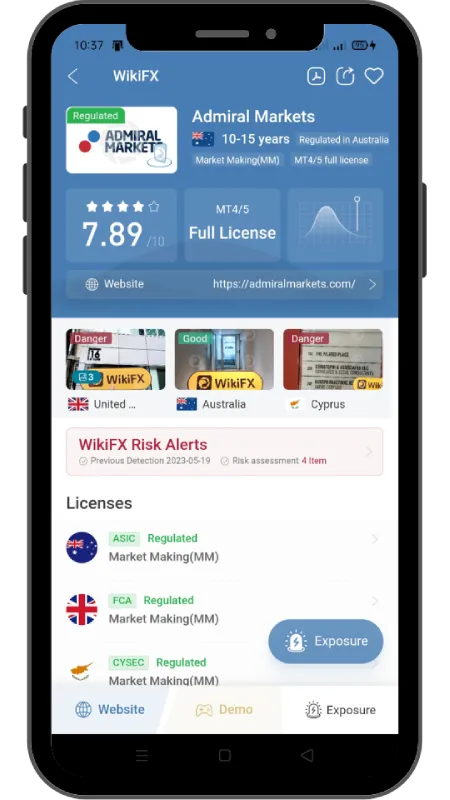
Admiral Markets is governed by some of the world's most reputable financial regulators. The Financial Conduct Authority (FCA), the Cyprus Securities and Exchange Commission (CySEC), the Australian Securities and Investments Commission (ASIC), and the Jordan Securities Commission (JSC) regulate their offices in the United Kingdom, Cyprus, Australia, and Jordan, respectively. These regulatory agencies make certain that the corporation follows a stringent set of standards meant to safeguard its consumers.
Admiral Markets is also a member of the Financial Services Compensation Scheme (FSCS) in the United Kingdom. This program provides additional security by covering customers in the event that the firm is unable to meet its financial commitments.
Download and install the WikiFX App on your smartphone to stay updated on the latest news.
Download the App here: https://social1.onelink.me/QgET/px2b7i8n