Abstract:On Friday, the Australian Securities and Investments Commission (ASIC) affirmed the remade class order, which defines the financial criteria of retail over-the-counter (OTC) derivatives issuers.
The regulations define the standards for non-tangible assets.
Retail OTC derivatives issuers need to comply with these requirements.
On Friday, the Australian Securities and Investments Commission (ASIC) affirmed the remade class order, which defines the financial criteria of retail over-the-counter (OTC) derivatives issuers.
The order extending the requirements for another five years came just as the previous order was set to expire on January 1. Before issuing the order, the regulator also issued a public consultation paper.
It requires retail OTC derivatives issuers with an Australia Financial Services (AFS) license to maintain a minimum tangible asset of AU$1 million, or 10% of their typical revenue. Half of these firms' needed net-tangible assets must be cash and cash equivalents, with the other half being liquid assets.
Derivatives issuers must also submit quarterly predictions of their yearly cash flows. In addition, if AFS license holders fail to meet the standards, they must additionally meet trigger point reporting duties.
“The financial requirements are intended to ensure that Australian financial services licensees have adequate financial resources to operate their businesses in accordance with the Corporations Act 2001 and to manage the operational risks inherent in the OTC derivatives market,” the regulator stated.
Other Intervention Orders Issued by ASIC
Meanwhile, the Australian regulator is imposing limits to reduce the risks faced by ordinary traders. It has prolonged the prohibition on binary options until October 1, 2031, from the initial date of implementation in May 2021.
Furthermore, ASIC established stringent controls on the leverage supplied to retail customers by registered brokers, as well as their marketing strategies. It extended such limits earlier this year for another five years, to May 23, 2027.
About ASIC (Australian Securities and Investments Commission)
The Australian Securities and Investments Commission (ASIC) is an independent Australian government entity that serves as Australia's business regulator. It was founded on July 1, 1998, in response to the Wallis Inquiry's recommendations. The purpose of ASIC is to enforce and regulate corporate and financial services laws in order to safeguard Australian consumers, investors, and creditors. The Australian Securities and Investments Commission Act, 2001 established ASIC's jurisdiction and scope.
About WikiFx
Wikifx is a platform for searching worldwide company financial information. Its primary duty is to give the included foreign exchange trading organisations with basic information searching, regulatory licence seeking, credit assessment, platform identification, and other services.
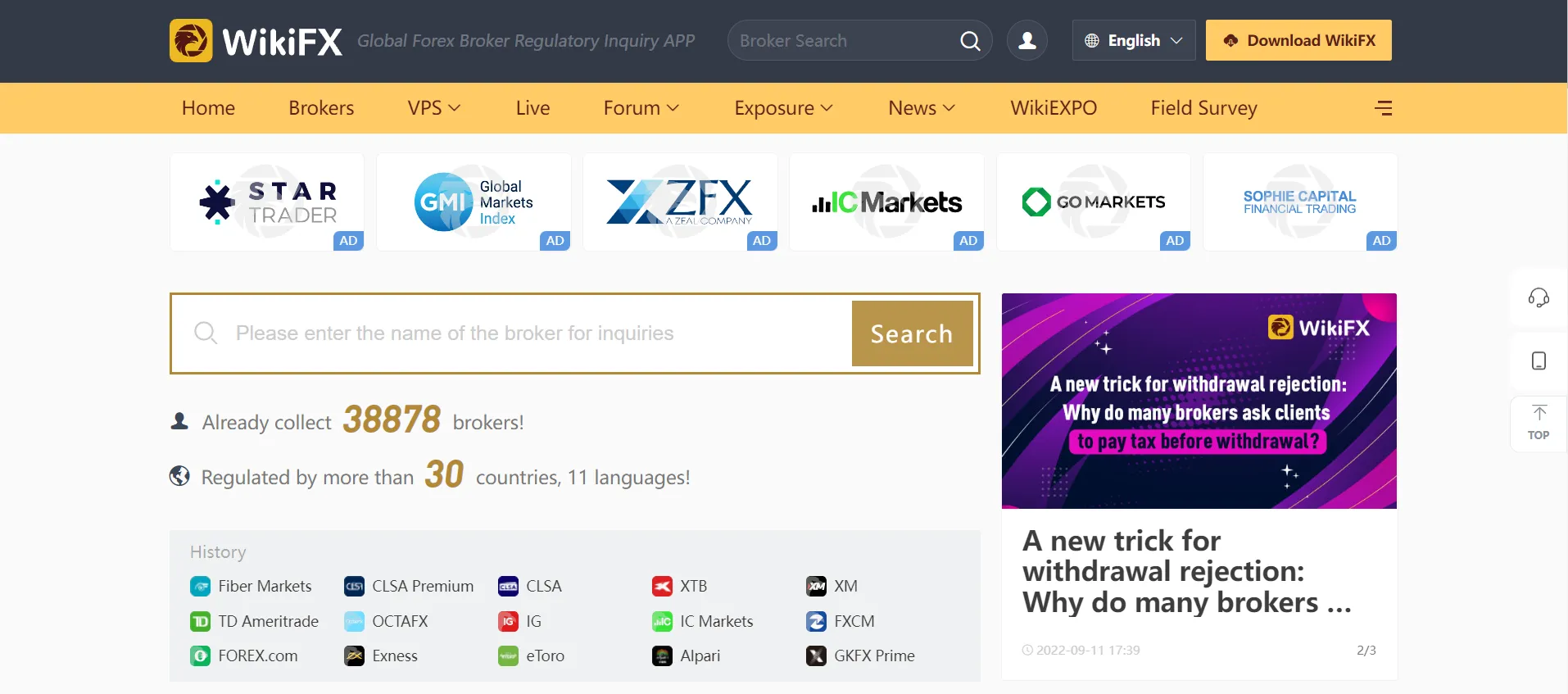
Wikifx has created a big data solution that unifies data gathering, data screening, data aggregation, data modelling, and data productization using public data from government agencies, sophisticated sniffer systems, and scientific computer algorithms. Wikifx may then assess the supervision and risk levels of the associated organisations across several dimensions and give matching security solutions to individual users, corporate users, and government agencies.
Keep an eye out for more regulatory updates.
WikiFX App may be downloaded through the App Store or the Google Play Store.