Abstract:An introducing broker is paid a rebate out of the spread markup the client already pays, while a white label is a separate brand running on a provider's platform and often under its licence. The article follows that money path with a simple formula, a clearly hypothetical walkthrough that needs no live price, and the back office records where IB payments and white label accounting meet.

 Contents
Four names behind one trading account
A retail forex account rarely involves just two parties. Between your deposit and the price on your screen sit several roles, and knowing which one does what makes the costs easier to read. This is about who earns what and who answers for it, not about which firm to use.
- Broker (also called a dealer): the firm that holds your account, shows prices and executes your orders. In most retail setups it is also the counterparty, meaning the other side of your trade.
- Introducing broker (IB): a person or company that brings clients to a broker and is paid a share of the revenue those clients generate. An IB usually does not hold your money and does not execute your orders.
- White label: a brand that rents another firm's platform and pricing, and often its licence cover (the regulatory permission to operate), then trades under its own name.
- Back office: the systems behind the brand, where client records, order routing and payment ledgers live.
Each role can sit in a different company. The name printed on your client agreement is the one that tells you which legal entity you actually face.
How a rebate is built, step by step
A rebate is money paid to the IB out of the cost of the trades it introduced. Two structures are common: a fixed amount per lot traded, or a percentage of the markup, which is the small extra charge the broker adds on top of the price it gets from its suppliers. A lot is a standard trade size, and for most pairs a standard lot means 100,000 units of the base currency. The percentage version is easier to follow because it shows where the money starts.
IB rebate = volume in lots × pip value per lot × markup in pips × IB share
- Start with the raw spread, the difference between the buy and sell price the broker obtains from its liquidity providers, the firms that quote tradable prices to it.
- Add the markup, measured in pips, where a pip is the smallest conventional price step quoted for a currency pair.
- The client trades at the total spread, raw plus markup, and never receives a separate bill for the difference.
- That markup revenue is split: the broker keeps a share, and an agreed percentage goes to the IB that introduced the account.
In this chain the rebate is not a gift from the broker. It is a slice of a cost the client has already paid.
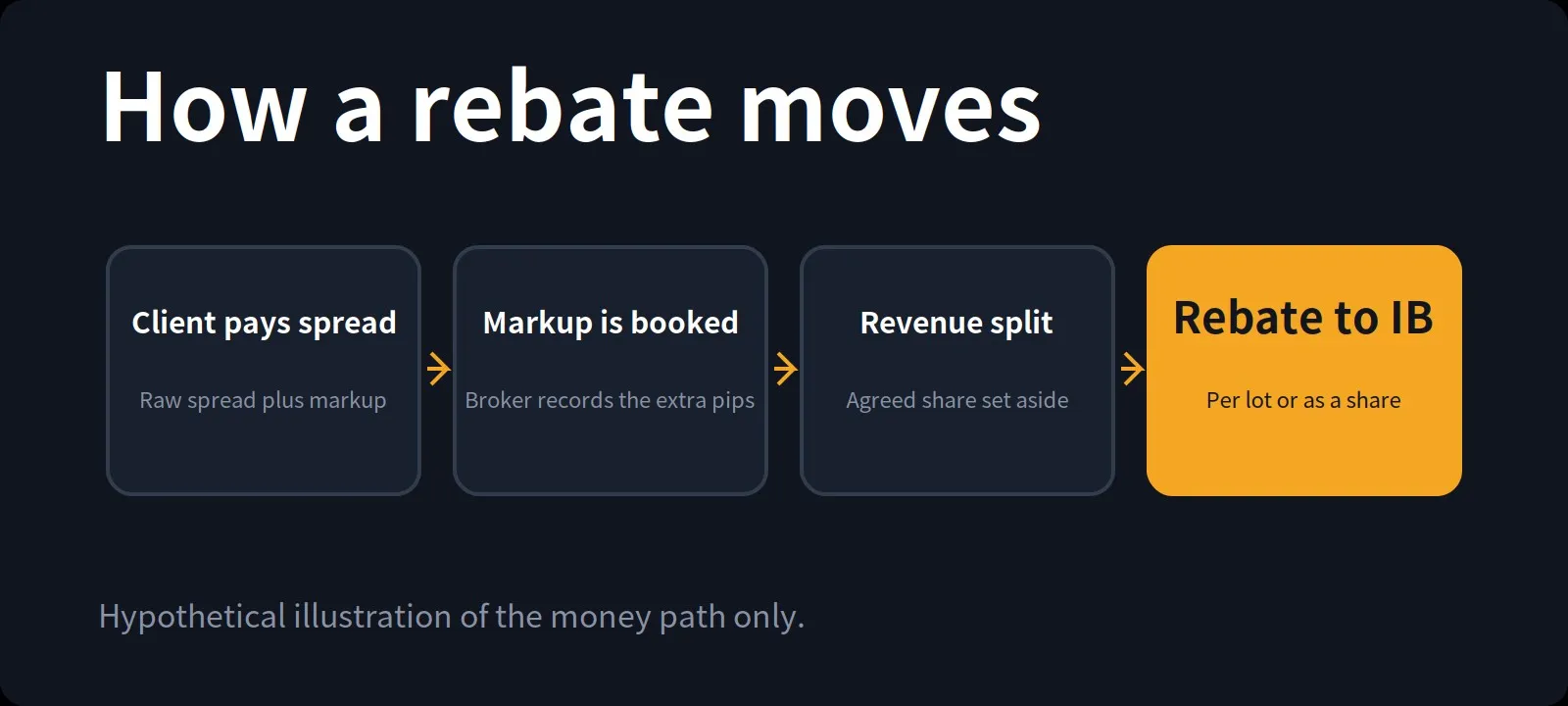
Markup becomes revenue before any rebate exists.
A hypothetical run-through
Assume, purely for illustration, that you trade EURUSD in standard lots and that a broker quotes a markup of 0.5 pip. One pip on EURUSD is 0.0001, so one pip on a standard lot is worth 10 US dollars. Assume the IB's agreed share is 40 percent and that the month's volume is 12 standard lots. No live price is needed for this arithmetic.
- Volume for the month: 12 standard lots
- Gross markup revenue: 12 × 10 × 0.5 = 60 US dollars
- IB rebate at 40 percent: 60 × 0.4 = 24 US dollars
So the client paid 60 dollars in embedded markup and the IB received 24 of them. Nothing here is a live quote, a recommendation or a forecast; the numbers only show how the arithmetic fits together. The same client trading 24 lots would double both figures while the cost per lot stays the same.
Where the white label sits in the back office
A white label lets a company present a full trading brand without building the plumbing itself. The provider supplies the platform, the price feed and often the regulatory cover; the brand supplies marketing, local support and client acquisition. That split matters most when something goes wrong.
- Licence holder: the regulated entity named in the client agreement, responsible for compliance and for handling complaints.
- Brand operator: the company you deal with day to day, which may not be the licence holder.
- Pricing control: the markup is often set at provider level, though some arrangements let the brand adjust it.
- Rebate ledger: the record linking each introduced account's volume to payments. This is where IB and white label accounting usually meet.
If two firms both look like your broker, the client agreement is the document that settles it, together with whichever regulator supervises that entity in your market.
What this setup is and is not
An IB is a distribution channel, not a broker. A white label is a brand running on someone else's infrastructure, which is not automatically a warning sign and not automatically a mark of safety either. The mistakes below are common, and each one is worth checking before you sign anything.
- Mistake: assuming a rebate lowers your cost. It usually comes out of the cost you already pay, and a generous rebate can sit on top of a wider markup.
- Mistake: treating the brand name as the regulated entity. Check which company appears in the agreement and which authority supervises it.
- Mistake: expecting an IB to handle your orders. It does not route or fill trades; the broker does.
Knowing the chain tells you who earns from the spread and who answers for it. It says nothing about whether trading suits your circumstances, and it is not a reason to open an account with anyone.
Finally, WikiFX would like to remind everyone that before using any US stock, futures, or forex brokers, remember to check the platform's regulatory information, trading environment, field inspection reports, user reviews, and overall rating on the WikiFX App. This will help you effectively avoid problematic scam platforms and rogue brokers, safeguarding your capital.