Abstract:India's foreign-exchange market is witnessing a sharp slowdown in dollar hedging activity as the Reserve Bank of India (RBI) tightens restrictions on currency derivatives to curb speculative trading and support the weakening rupee. The regulatory crackdown is changing how banks and businesses access dollar protection, raising concerns about liquidity, transaction costs and the ability of companies to manage currency risks.
The RBI's measures have helped reduce speculative dollar demand and supported the rupee's recovery. However, the restrictions have also made banks more cautious about providing forward contracts, while uncertainty over regulatory requirements has disrupted trading activity in the onshore currency market.
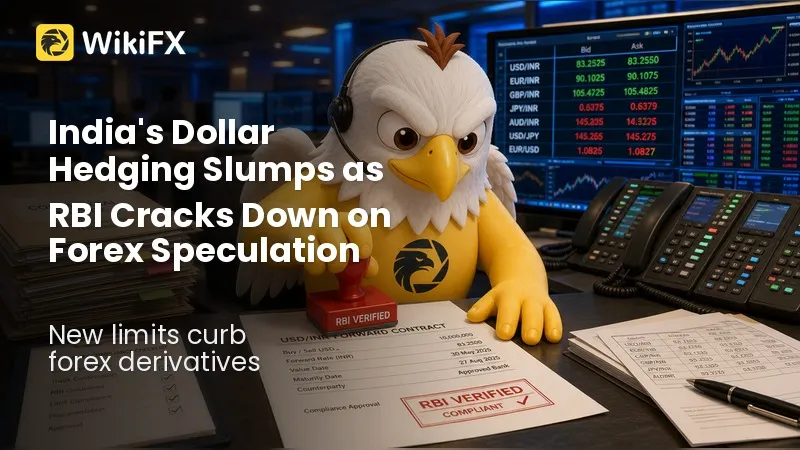
India's foreign-exchange market is witnessing a sharp slowdown in dollar hedging activity as the Reserve Bank of India (RBI) tightens restrictions on currency derivatives to curb speculative trading and support the weakening rupee. The regulatory crackdown is changing how banks and businesses access dollar protection, raising concerns about liquidity, transaction costs and the ability of companies to manage currency risks.
The RBI's measures have helped reduce speculative dollar demand and supported the rupee's recovery. However, the restrictions have also made banks more cautious about providing forward contracts, while uncertainty over regulatory requirements has disrupted trading activity in the onshore currency market.
 Contents
Why is Dollar Hedging Declining?
The RBI introduced a series of measures in October after the rupee approached record lows against the US dollar. The central bank lowered the threshold for foreign-exchange derivative transactions without establishing an underlying exposure from $100 million to $5 million.
It also prohibited the rebooking of cancelled rupee-linked derivative contracts and introduced a Foreign Exchange Risk Reserve (FERR), requiring banks to maintain a cash reserve equivalent to 20% of the notional value of qualifying derivative transactions exceeding $2 million.
These measures are intended to discourage excessive speculative positions, prevent repeated contract cancellations and ensure that currency derivatives are primarily used for genuine business requirements.
However, the additional compliance requirements and higher funding costs have prompted banks to reassess their participation in the forward market. Some lenders have become more selective about offering dollar hedges, while others have temporarily restricted access to online hedging platforms as they review the new requirements.
Reuters reported that dollar-rupee forward trading volumes declined following the regulatory changes, with wider bid-ask spreads and increased volatility highlighting the disruption.
How Businesses and Banks are Affected
Indian importers are among the businesses most exposed to the RBI's latest restrictions. Companies purchasing crude oil, electronics, machinery and other goods from overseas depend on forward contracts to protect themselves against fluctuations in the rupee-dollar exchange rate.
Higher hedging costs could make these protections more expensive, forcing businesses to reconsider the size and duration of their currency positions. Some importers may opt for shorter-term contracts, while others could delay hedging until their payment obligations approach.
Banks are also facing increased funding and compliance requirements. The additional cash reserve tied to qualifying derivative transactions reduces the funds available for other activities and can increase the cost of providing currency protection to customers.
According to Reuters, the new measures have already encouraged importers to concentrate more heavily on shorter-term forward contracts, with banks passing additional hedging costs on to clients.
Will the RBI's Crackdown Stabilise the Rupee?
The RBI's intervention comes amid persistent pressure on the Indian currency from elevated crude oil prices, foreign investment outflows and strong demand for dollars.
By redirecting state-owned oil refiners' dollar purchases through a special window and restricting speculative activity in the derivatives market, the central bank is attempting to reduce demand in the open foreign-exchange market.
The measures initially supported the rupee, but they have not eliminated the underlying demand for dollars. Recent market developments also suggest that investors remain concerned about further currency weakness, despite the rupee's recovery.
Reuters reported on November 3 that forward premiums had risen significantly above levels implied by the India-US interest-rate differential, while reduced onshore trading activity had increased volatility and contributed to sharp movements in offshore markets.
What Traders and Investors Should Watch
The slowdown in dollar hedging activity highlights a growing challenge for India's foreign-exchange market: controlling speculative trading without restricting legitimate currency-risk management.
Importers, exporters and businesses with foreign-currency liabilities will need to monitor changes in hedging costs, forward premiums and liquidity conditions. Forex traders should also watch the RBI's policy signals, USD-INR movements and differences between onshore and offshore currency pricing.
For retail forex and CFD traders, the developments underline the importance of understanding currency-market volatility and choosing properly regulated trading platforms. Investors should verify broker credentials, understand the risks associated with leveraged currency products and avoid platforms promising guaranteed returns.
The bigger question is whether the RBI can discourage speculative dollar demand without making genuine hedging increasingly difficult for Indian businesses. While tighter controls may provide short-term support to the rupee, sustained currency stability will also depend on crude oil prices, foreign capital flows and India's broader external-sector fundamentals.
The RBI has been actively taking stock of India's forex reserves in the wake of a broader decline in the rupee against the dollar. Its decisions and estimates can impact traders. Watch regular RBI updates on WikiFX. Download the app now!
Knowledge pays at WikiFX.Every time you share a WikiFX article, you'll receive 50 Reward Points. Grow your rewards with every share and unlock exclusive gifts in the WikiFX Points Mall. Start earning today!