Global Broker Regulation Inquiry App
About WikiFX


UK and Singapore Align Digital Money and Tokenisation Rules at 11th Financial Dialogue
WikiFX
|


Abstract:The UK and Singapore held their 11th Financial Dialogue in Singapore on 20 October 2026, covering tokenisation, stablecoins, AI in finance, capital markets and transition finance ahead of 2027 G20 and ASEAN roles.
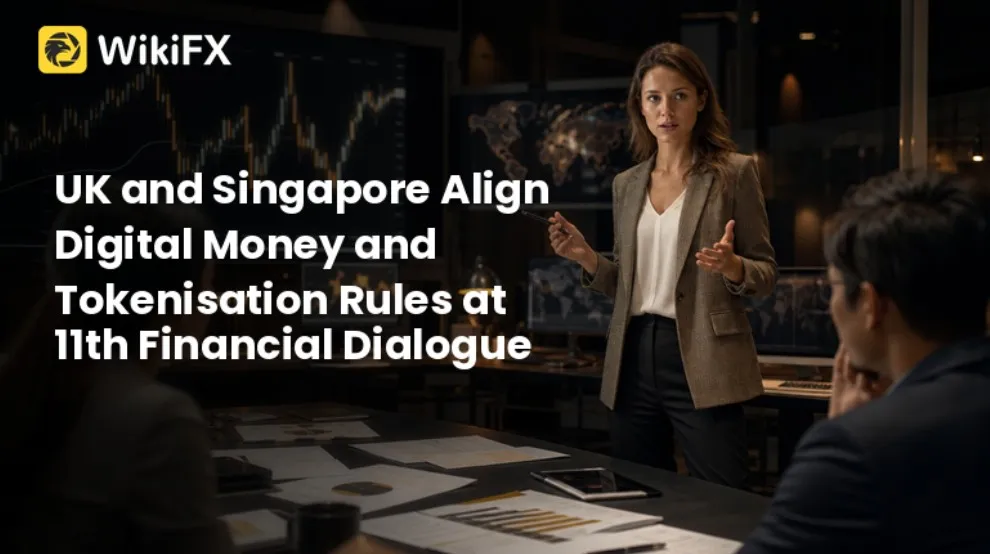
The United Kingdom and Singapore held the 11th UK-Singapore Financial Dialogue in Singapore on 20 October 2026, with discussions centred on digital finance and innovation, capital markets, sustainable finance, and regional and multilateral initiatives. According to the Monetary Authority of Singapore (MAS), the meeting reaffirmed what both sides described as a strong and longstanding partnership between the two financial hubs.
The dialogue is a regulatory and policy coordination forum rather than a monetary policy event. No interest rate or currency decision emerged from the meeting, and the release made no reference to the Singapore dollar nominal effective exchange rate (SGD NEER) band, through which MAS conducts monetary policy. For forex beginners, the relevance lies in the plumbing behind cross-border payments and digital money, which the two jurisdictions are shaping jointly.
 Contents
Tokenisation, Stablecoins and the Settlement Plumbing
On digital assets and financial market infrastructure, the two sides covered initiatives from both jurisdictions aimed at supporting cross-border use cases for tokenisation and wholesale digital markets. Tokenisation refers to representing assets such as bonds or fund units as digital tokens that can be transferred and settled on shared ledgers, a step that could change how institutional payments and securities settlement work across borders.
Singapore-side initiatives cited included MAS's Project Guardian and BLOOM, and Global Layer One (GL1). On the UK side, the discussion covered the Wholesale Financial Markets Digital Strategy, the work of the UK Wholesale Digital Markets Champion, the Digital Securities Sandbox, and ongoing work by the Bank of England (BoE) and the Financial Conduct Authority (FCA) on tokenisation and wholesale digital markets.
The dialogue also covered developments in crypto-assets and stablecoins, and the implications of digital money for wholesale markets and institutional settlements. Stablecoins are digital tokens typically designed to hold a steady value against a reference asset such as a fiat currency, and their use in institutional settlement is a live policy question for both hubs.
AI Safeguards, Quantum Security and Shared Sandboxes
The dialogue affirmed the importance of safe and responsible AI adoption in financial services. Initiatives discussed included the UK's AI Adoption Plan for Financial Services and related measures under its Financial Services Strategy, alongside Singapore's Safeguards for Agentic Finance at Runtime (SAFR), a framework setting out how AI agents may carry out financial tasks safely, securely and reliably.
MAS and the FCA also reviewed progress under the UK-Singapore AI in Finance Partnership, including PathFin.ai, Spotlight, the FCA Supercharged Sandbox, the AI Observatory and ongoing work on an AI taxonomy. Discussions covered practical approaches and good practices for responsible AI adoption, and possible use cases for future cooperation.
On quantum technologies, the exchange covered both countries' approaches to quantum security and supervisory expectations for financial institutions moving to quantum-safe technologies. Specific inputs included the UK National Cyber Security Centre's post-quantum cryptography migration guidance and lessons from MAS's Quantum Key Distribution sandbox with industry partners.
Capital Markets, Transition Finance and the 2027 Platform
On capital markets, HM Treasury shared progress on the UK's programme of capital markets reforms and on measures to broaden access to private capital. MAS updated on the suite of measures introduced by Singapore's Equities Market Review Group to strengthen the competitiveness of the local equities market.
Both sides also discussed efforts to strengthen their growth capital ecosystems. HM Treasury provided an update on the British Business Bank's venture and growth capital initiatives, while MAS shared on Singapore's Growth Capital Workgroup and its efforts to strengthen financing across deal origination, capital raising and capital recycling.
On sustainable finance, the UK shared updates on the Transition Finance Pilot, the Transition Finance Council Guidelines and the Green Finance Institute's Transition Finance Lab. It also shared lessons on supporting climate adaptation through insurance markets, the FCA's Climate Scenarios Sandbox, and the Climate Financial Risk Forum jointly convened by the FCA and the BoE. Singapore outlined ongoing revisions to the Singapore-Asia Taxonomy 2.0 and its experience with the Financial Sector Carbon Market Grant.
The wider diplomatic calendar featured in the talks. In 2027 the UK will assume the G20 Presidency and Singapore will hold the ASEAN Chairmanship, and both countries discussed their priorities for those roles and opportunities for collaboration. They also exchanged views on the future work programme of the Financial Stability Board, which is chaired by the Governor of the Bank of England.
An industry-led UK-Singapore business roundtable follows on 21 October, with representatives from both countries set to cover opportunities for international cooperation, particularly in the context of the 2027 G20 and ASEAN roles.
Officials from HM Treasury and MAS took part alongside representatives from the BoE, the FCA, the High Commission of the Republic of Singapore in London and the British High Commission in Singapore. The dialogue was preceded by a bilateral discussion between Ms Gwyneth Nurse, Director General (Financial Services) at HM Treasury, and Mr Leong Sing Chiong, Deputy Managing Director (Markets and Development) at MAS, who re-affirmed the value of close and wide-ranging engagement between the two countries. The 12th UK-Singapore Financial Dialogue will be hosted by the UK in 2027.
Disclaimer:
The views in this article only represent the author's personal views, and do not constitute investment advice on this platform. This platform does not guarantee the accuracy, completeness and timeliness of the information in the article, and will not be liable for any loss caused by the use of or reliance on the information in the article.
WikiFX Broker
Latest News
Nigeria's Weekly Dollar Trading Falls 22% to $2.62 Billion as Forward Deals Plunge
WikiFXFirst Light News: Chip Bounce Fails to Inspire Asia & France Weighs on Europe
WikiFXInside WeTrade’s Exclusive Houston Rockets VIP Experience in Macao
WikiFXCFI Puts a Trading Behaviour Score and AI Assistant Inside Its App
WikiFXGlobal Markets Forecast: French Bond Yields Surge as Oil Retreats
WikiFXUS Dollar Price Forecast: Fed Hike Bets Fade, DXY Tests 102.18 as EUR/USD, GBP/USD Slip
WikiFXXTrend Speed Broker Exposed: What Are Other Traders Saying About This Broker?
WikiFXLeading the Transparency Movement, The Trust Dialogue with Vatee
WikiFXNigeria's Weekly Dollar Trading Falls 22% to $2.62 Billion as Forward Deals Plunge
WikiFXPlus500 to buy Brazilian broker-dealer Guru in Latin America push
WikiFX