Abstract:Navi Mumbai police have booked two men accused of running an unregistered investment scheme that promised returns of up to Rs 28 crore on deposits as small as Rs 2 lakh, built on a story about iridium supposedly found along the West Bengal-Bangladesh border.
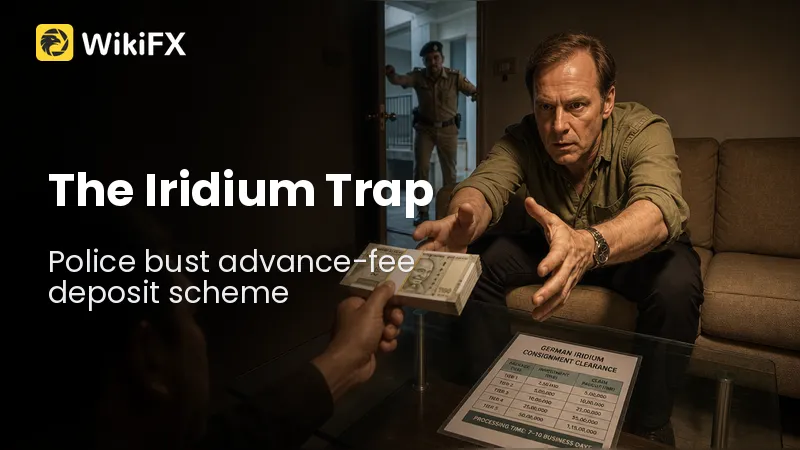
According to the Hindustan Times, the Economic Intelligence Cell of the Navi Mumbai police registered a case on Wednesday against Tirthankar Tushar Kanti Sengupta, 48, of Kolkata, and Jayant Anant Oak, 58, of Sector 16, Kamothe.
The case has drawn attention because of the scale of the promised payouts and the length of time the scheme is alleged to have run.
The Hindustan Times reported that police said around 500 investors had fallen prey to the scheme, while Mid-Day reported that it had duped around 300 investors since 2018 and that not a single victim had received a rupee back.
 Contents
How the alleged scheme was pitched
The suspected fraud came to light after the Economic Intelligence Cell was tipped off that some individuals were allegedly soliciting investments by promising disproportionate returns from the purported sale of iridium particles, according to the Hindustan Times.
An officer, Suraj Kiran Gore, was authorised to pose as a prospective investor to verify the information.
According to the FIR, Gore contacted an agent, Jayant Oak, through an informant. Oak arranged a meeting with Tirthankar Sengupta at a hotel in Turbhe on October 13. At that meeting,
Sengupta allegedly claimed that they had discovered iridium along the West Bengal-Bangladesh border and that five custodians, including him, were entitled to half of Rs 3.34 lakh crore received from its sale to Germany.
Mid-Day reported that Sengupta allegedly claimed he and four others were “custodians” of iridium found on the border, which the Centre had supposedly sold to Germany for Rs 334 lakh crore.
Half of that amount, or Rs 167 lakh crore, was allegedly theirs, but officials had to be paid to release it, and investors' money was needed for this, he claimed.
The decoy investor was told that putting Rs 5 lakh into the scheme would yield Rs 9 crore to Rs 28 crore by the end of November 2026. Gore expressed his willingness to invest Rs 5 lakh, paid Sengupta Rs 1 lakh in cash as an advance, and audio-recorded the conversation, the Hindustan Times reported.
Mid-Day reported that both accused were detained the moment Sengupta accepted the Rs 1 lakh cash advance.
Investor numbers and the chain network
Gore then filed a complaint stating that the accused claimed around 500 people had invested in the scheme, with each contributing an average of Rs 4 lakh to Rs 5 lakh.
The complaint also stated that the accused had been collecting deposits since 2018 but had not paid the promised returns or returned the principal amount to investors. They continued seeking investments by promising that the money would be released in November 2026.
Mid-Day reported that investigators said the racket operated through a chain of custodians, beneficiaries and agents spread across states who allegedly lured people into investing Rs 2 lakh to Rs 8 lakh each. Initial findings indicated that around Rs 4 lakh to Rs 5 lakh was collected from each investor.
Police are also probing whether one of the accused was himself taken in by the same story, according to Mid-Day. Mid-Day reported that victims can contact the FIU helpline on 7700920766.
Charges and what happens next
Based on the complaint, Navi Mumbai police registered an FIR against Oak and Sengupta under sections 318(4) and 316(5) of the Bharatiya Nyaya Sanhita and sections 3, 5, 21 and 23 of the Banning of Unregulated Deposit Schemes Act, 2019, the Hindustan Times reported.
The Banning of Unregulated Deposit Schemes Act is a law meant to stop schemes that collect money from the public without registration or regulatory approval.
The Bharatiya Nyaya Sanhita is India's criminal code, which replaced the Indian Penal Code. The sections cited in the FIR relate to cheating and to the collection of deposits outside the permitted framework.
Why the case matters for ordinary savers
Iridium is a hard, silvery metal that belongs to the platinum group and is used in products such as spark plugs, crucibles and certain electronics.
It is traded in small volumes compared with gold or silver, and its price moves with industrial demand and supply rather than being fixed by any authority. That makes claims of a guaranteed, government-linked payout from iridium unusual on their face.
For anyone new to foreign exchange or commodity markets, the pattern described in the FIR is a familiar one: a story about a rare or valuable material, a promise of very large and quick returns, and a reason why money must be paid now to unlock a bigger sum later.
Genuine commodity prices rise and fall, and no registered product offers a fixed multiple of the amount invested within a set number of months.
The two accounts of how many people were affected, around 500 according to the Hindustan Times and around 300 according to Mid-Day, both point to a scheme that ran for years before the police acted.
The FIR states that deposits were collected from 2018 onwards, and that investors were told the money would be released in November 2026, a date that has now passed without any payout being reported.