

Global Broker Regulation Inquiry App
About WikiFX
English
简体中文
繁體中文
English
Pусский
日本語
ภาษาไทย
Tiếng Việt
Bahasa Indonesia
Español
हिन्दी
Filippiiniläinen
Français
Deutsch
Português
Türkçe
한국어
العربية
اردو


Why Fake Screenshots Make You Feel Like a Losing Trader

WikiFX
|


Abstract:Survivor bias and fake screenshots distort your expectations before you even place a trade. Learn the psychological filter and how to see through it.
Every few days, someone in your feed posts a screenshot of a currency trade that went perfectly. Green numbers, a few hundred ringgit turned into a few thousand, and a caption that makes it sound easy. If you are still learning forex, these posts can feel like proof that everyone else has figured it out while you are stuck.
Most beginners do not realise what they are missing: the silent majority who lose money, stop posting and vanish. This is not a lack of skill; it is a filter your social feed applies automatically. The effect has a name: survivor bias.
 Contents
Why Your Feed Shows Only Winners
Survivor bias is the error of judging a situation by the outcomes that are still visible, while the failures have quietly dropped out of view. In trading, this means you see the screen of winners, not the graveyard of losers.
Imagine a hypothetical group of 100 new traders. Say 96 of them lose a meaningful part of their accounts and, understandably, stop posting about trading. The remaining 4 have profitable months and happily share screenshots.
Your feed shows you only those 4, so the invisible reality is flipped: it looks like every trade is a winner when every post is a winner. Even within those 4, a screenshot may be cherry-picked. A trader can post their best day while ignoring five losing days. Some posts are simply fabricated.
The point is not that every screenshot is fake; it is that you are rarely given the denominator.
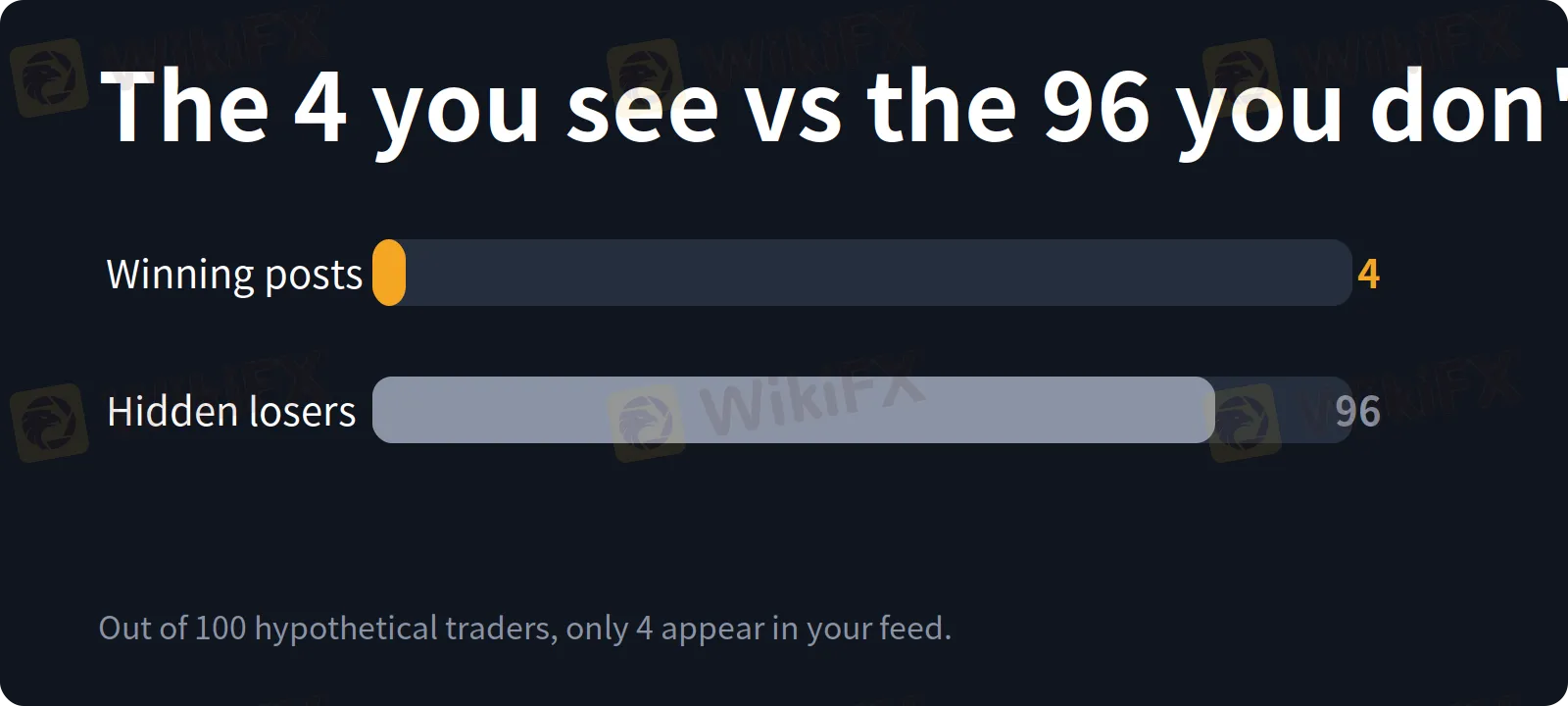
Hypothetical illustration only.
The Emotional Toll: When Comparison Becomes a Mirror
Seeing constant winners does not only change your opinion of the market; it changes your opinion of yourself. It feeds an availability heuristic, the mental shortcut where you judge probability by how easily an example comes to mind. If you can picture someone earning a month's salary from one trade, your mind treats that outcome as common.
When you then log into your own account and see small, slow progress, the gap creates anxiety. This anxiety can push you toward decisions you might not make on a calm day: larger size, earlier entry, a tighter stop. You feel left behind even though the race you are watching was never real.
Psychologists call the habit of measuring yourself against others social comparison. It is normal, but when the comparison group is fake, it is like weighing yourself against a ghost.
Three Questions to Ask Before You Believe a Screenshot
Here is a simple self-check you can run the next time a screenshot makes your stomach clench. These are observations, not trading advice.
- What is the denominator? Ask how many trades this person actually took before this screenshot. A single winning trade does not tell you about the other 20. If the post does not show the history, treat it as an anecdote.
- What emotion is it triggering? Name the feeling: envy, urgency, shame, excitement. The emotion itself is a signal that your attention has been hijacked. You do not need to act on it.
- Can I do anything with this information? Does the post show entry, exit, stop-loss and the reason for the trade? If not, treat it as entertainment, not education.
Fake or heavily filtered screenshots are not your fault, but the discomfort they create is real. The useful skill is not learning to ignore them; it is learning to notice how they change your mood. Walk away, write down what you felt, and give yourself permission to compare your progress with a more honest sample: your own past, once you keep your own records.
Disclaimer:
The views in this article only represent the author's personal views, and do not constitute investment advice on this platform. This platform does not guarantee the accuracy, completeness and timeliness of the information in the article, and will not be liable for any loss caused by the use of or reliance on the information in the article.
WikiFX Broker
Latest News
StoneX Agrees to Acquire Brazil FX Bank Banco Travelex
WikiFXVonway Review: Withdrawal Complaints and a Regulator Warning
WikiFXReview 2026: GFS Withdrawal Complaints, Regulation Gaps, and Broker Risk Signals
WikiFXVG Markets Review: A Real FSCA Licence, But Why Only a 4.47 Score?
WikiFXTriumphFX Review: Revoked Licence and TFX Token Losses Warrant Caution
WikiFXReview 2026: STMARKET Regulation, MT5 Access, and Withdrawal Complaint Signals
WikiFXNigeria's net FX flow falls 29% to $4.94bn in March
WikiFXPocket Option Review 2026: Complaints, Withdrawals, and Unregulated Risk
WikiFXPlus500 Joins Bahamas Forex and CFD Industry Association
WikiFXMalaysian Doctor Loses RM558,000 to Forex-Crypto Scam
WikiFX