

Global Broker Regulation Inquiry App
About WikiFX
English
简体中文
繁體中文
English
Pусский
日本語
ภาษาไทย
Tiếng Việt
Bahasa Indonesia
Español
हिन्दी
Filippiiniläinen
Français
Deutsch
Português
Türkçe
한국어
العربية
اردو


Review 2026: RaiseFX Regulation Warnings, MT5 Access, and Complaint Risks

WikiFX
|


Abstract:RaiseFX shows a mixed-to-high risk profile: WikiFX lists South African FSCA-related regulation, but one entry is marked unverified and European regulators have issued unauthorized-company warnings. The low WikiFX Score of 2.25, regulatory disclosures, and user complaints about withdrawals and account freezing mean traders should be cautious before depositing.
Executive Summary (TL;DR): RaiseFX is a South Africa-based broker established in 2021 with a WikiFX Score of 2.25, which should be treated as a live risk indicator rather than a permanent rating. WikiFX shows one South African FSCA entry as regulated and another as unverified, while Spain‘s CNMV and France’s AMF have published unauthorized-company warnings linked to RaiseFX. User exposure cases also mention unexplained withdrawal deductions and account freezing, so you should review the evidence carefully before funding an account.
In this review, RaiseFX looks less straightforward than a simple “regulated or not regulated” label. Before you find a broker for Forex trading, the key question is not only whether a license appears somewhere, but whether the exact entity, website, and service region match the authorization.
RaiseFX has a WikiFX Score of 2.25 and an influence rank of B. The available data says its influence is mainly distributed across the United Arab Emirates, Bulgaria, Switzerland, Germany, France, the United Kingdom, India, Italy, Morocco, and Russia, with an average influence index of 6.08. Those visibility figures do not remove the safety questions. For a trader, the more important signals are the regulation status, regulator warnings, platform access controls, and complaint history.
 Contents
Regulation and Safety
WikiFX lists RaiseFX as headquartered in South Africa and established in 2021. The safety data names the South African Financial Sector Conduct Authority, commonly referred to as the South Africa FSCA, as the relevant regulator.
There are two FSCA-related entries in the data. One is for INSELE CAPITAL PARTNERS with regulation number 50455, marked as “unverified.” The other is for RAISE GLOBAL SA (PTY) LTD with regulation number 50506, marked as “regulated.” This creates a mixed regulation picture. You are not looking at a clean single-entity record; you are looking at a broker profile where one regulatory item is recognized as regulated, while another is explicitly flagged as unverified.
That matters because broker protection depends on the exact legal entity you contract with. If your account agreement, payment recipient, website, or client portal is tied to an entity different from the regulated one, your practical protection may be weaker than the headline license suggests. Before depositing, check whether the name on the account documents matches RAISE GLOBAL SA (PTY) LTD and the FSCA number shown in the WikiFX data.
Regulatory Disclosures from Europe
The strongest warning signals in the provided data come from European regulators. WikiFX records three regulatory disclosures involving RaiseFX.
Spain‘s National Securities Market Commission, the CNMV, issued an unauthorized-company warning dated October 21, 2024. The disclosure states that https:// RaiseFX .com RaiseFX was not authorized to provide restricted investment services and activities under Spain’s Securities Markets and Investment Services Law, including financial instruments such as foreign exchange trading.
Frances Financial Markets Authority, the AMF, also appears in the disclosures. One AMF entry dated November 4, 2022 places the company or website on a blacklist of unauthorized companies and websites related to Forex. Another AMF announcement warns about entities or websites that are not authorized to offer services in France and reminds the public to check official registers and beware of identity misuse.
These disclosures do not automatically prove every user experience with RaiseFX is fraudulent. But they are serious. If a regulator says a broker or website is not authorized to offer investment services in a country, you should treat that as a clear service-region risk. A broker may have one form of offshore or foreign authorization while still being unauthorized to solicit or serve clients in another jurisdiction.
WikiFX Score and Risk Signals
RaiseFX has a WikiFX Score of 2.25. Scores can change as new data appears, but a low score combined with regulatory disclosures and user exposure cases is not something to ignore.
The broker profile also lists disadvantages including “questionable regulatory status,” “multiple exposure reports,” and “negative regulatory disclosures.” Those are not minor presentation issues. They are the kind of signals you should resolve before transferring funds, especially if you are trading Forex products where disputes can become difficult once money has moved through card payments, bank wire, or crypto-related channels.
Platform and Account Access
RaiseFX uses the MT5 trading platform, and WikiFX labels its software qualification as a main-label MT4/5 platform. MT5 is widely used in the industry and is known for customization, multiple language versions, good search functions, and clear fee reports. That is a positive platform detail.
However, the software review also says the login setup lacks two-step login and biometric authentication. That does not mean there are confirmed RaiseFX login failures in the data; none are provided. It does mean you should be more careful with account-access security. Use the official website only, avoid entering your password through links sent by strangers, and check the domain carefully before any login ** attempt involving funds or identity documents.
The listed website is https://raisefx.com/zh/ and is marked as legal in the WikiFX data. Still, because regulator disclosures refer to authorization problems and the AMF warning mentions identity misuse risks generally, traders should verify the exact URL, entity name, and payment instructions before proceeding.
Deposits, Withdrawals, and Support
The payment methods listed for RaiseFX include OZOW, SwiffyEft, VISA, MASTER, Wire Transfer, Google Pay, BTC, and Apple Pay. The data also says cryptocurrency is not allowed, while BTC appears in the fund-transfer list; that inconsistency is another reason to confirm payment rules directly before sending money.
Customer service details show support through English-language channels including X, telephone, email, Instagram, and LinkedIn. The phone number listed is +44 114 697 5338, and the email address is support.sea@raisefx.com. WikiFX notes that customer service can provide most relevant answers, but waiting times may be long.
Support availability is useful, but it does not solve the core risk if withdrawals, fee explanations, or account restrictions become disputed. In broker risk review, the real test is not whether contact channels exist. It is how the broker handles a user when money is being withdrawn.
Trader Complaints and Exposure Cases
Two exposure cases are available in the source data.
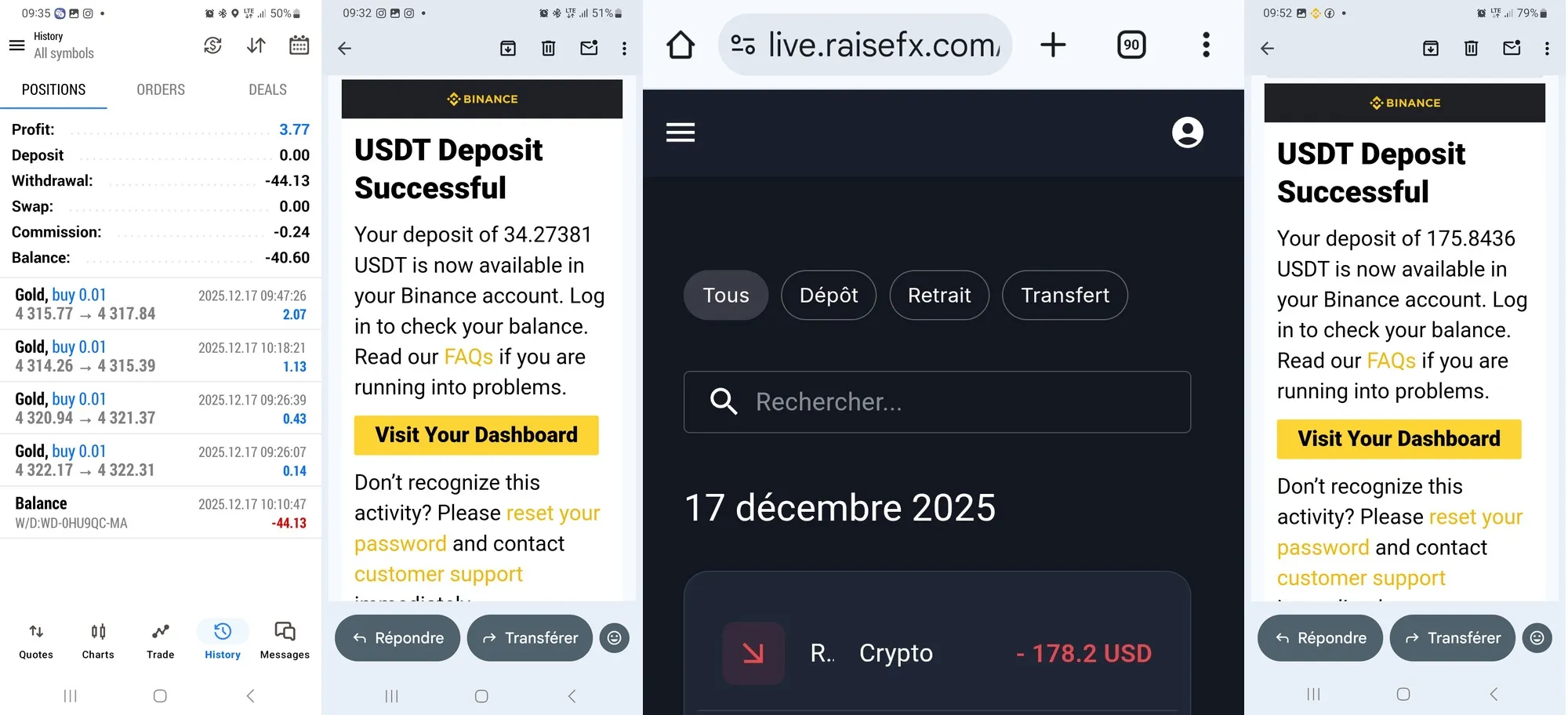
The first case, posted from Algeria on December 20, 2025, alleges unexplained deductions during withdrawals. The user said they withdrew $44 but received $34. RaiseFX reportedly explained the deduction as an ERC20 network charge, but the user said the withdrawal was made via TRC20. After the user provided proof, the broker allegedly described it as a normal new fee. The same user then said a later $178 withdrawal arrived as $175, creating inconsistent deduction amounts of $10 and $3 across two withdrawals. The complaint includes screenshots supplied by the user.
The second case, posted from Germany on April 28, 2024, is more severe. The user accused RaiseFX of a lack of transparency after the broker allegedly claimed arbitrage activity without providing concrete evidence. The user said the account was banned, the remaining balance was frozen, and a 20% penalty was applied to withdraw the initial deposit. The user also alleged that more than $3,000 was deleted across two accounts. This case also includes user-supplied screenshots.
These are user allegations, not court findings. Still, the pattern is relevant: both cases involve money access, deductions, freezes, penalties, or disputed explanations. If you already have funds with RaiseFX, keep records of balances, transaction IDs, chat logs, account notices, and withdrawal requests. If you are only considering an account, these cases are strong reasons to start with extra caution or avoid depositing until you can verify the brokers current status and terms.
Final Verdict: Should I open an account?
RaiseFX has some visible operating features, including MT5 access, multiple payment methods, and English support channels. But the risk signals are substantial: a low WikiFX Score of 2.25, one FSCA-linked entry marked unverified, three European regulatory disclosures, and exposure cases involving withdrawals and account freezing.
If you still want to proceed, do not rely on the brand name alone. Verify the exact legal entity, FSCA authorization number, website domain, fee schedule, withdrawal rules, and account terms before sending money. The available data does not provide spread, leverage, minimum deposit, or detailed Forex trading cost information, so confidence in the trading-condition side of this broker review is limited.
For most cautious traders, RaiseFX should be treated as a high-risk broker profile until the regulatory and complaint concerns are resolved with clear, verifiable evidence. Status changes daily. Before depositing, check the WikiFX App for the latest real-time certificate.

Disclaimer:
The views in this article only represent the author's personal views, and do not constitute investment advice on this platform. This platform does not guarantee the accuracy, completeness and timeliness of the information in the article, and will not be liable for any loss caused by the use of or reliance on the information in the article.
WikiFX Broker
Latest News
US Interest Rate Forecast: CPI to Test December Fed Hike Bets
WikiFXCMC Markets Secures LSEG Data Deal to Accelerate Global Expansion
WikiFXUS Dollar Price Forecast: DXY Eyes 102.49, Can EUR/USD Hold 1.1180 Ahead of CPI?
WikiFXIndian Police Arrest Two in Alleged ₹10 Crore Crypto Investment Fraud
WikiFXRM12.47 Million in Cryptocurrency Vanishes From Malaysian Man’s Wallet
WikiFXFirst Light News: US CPI, Aussie Jobs and Bank Earnings in Focus
WikiFXIndias retail inflation jumps to 5.54% in September, above estimates
WikiFXdbinvesting Broker Exposed: What Are Other Traders Saying About This Broker?
WikiFXFOREX.com Review 2026: Deposit & Withdrawal Issues Persist, Traders Claim
WikiFXRBI Opens a Daily Dollar Window for Indian Oil, HPCL and BPCL — and Rewrites the Hedging Rules
WikiFX