

Global Broker Regulation Inquiry App
About WikiFX
English
简体中文
繁體中文
English
Pусский
日本語
ภาษาไทย
Tiếng Việt
Bahasa Indonesia
Español
हिन्दी
Filippiiniläinen
Français
Deutsch
Português
Türkçe
한국어
العربية
اردو


Review 2026: COINEXX Regulation, Withdrawal Complaints, and Account Access Risks

WikiFX
|


Abstract:COINEXX shows a high-risk profile in the available WikiFX data: it has a low WikiFX Score of 2.33, no verified financial regulation, and multiple recent exposure cases involving withdrawal delays, blocked account access, or extra payment demands. The broker offers MT4/MT5 and low entry conditions, but the safety evidence is weak enough that traders should be very cautious before depositing.
Executive Summary (TL;DR): COINEXX is listed as a Comoros-based broker established in 2018, with a WikiFX Score of 2.33 and no verified financial regulator found in the supplied data. The main risk signals are not just regulatory: recent user cases describe failed withdrawals, blocked account access, and demands for additional payments before funds could be released.
Before you find a broker to deposit with, the first question is not whether the account looks easy to open. It is whether your funds have meaningful protection if something goes wrong. In this review, COINEXX presents a mixed but risk-heavy picture: it offers familiar MT4 and MT5 platforms, a low minimum deposit, and ECN account conditions, yet the WikiFX data also shows weak safety coverage and several serious complaints.
The current WikiFX Score shown for COINEXX is 2.33. Treat that as a live data point, not a permanent verdict, but it is low enough to deserve attention before you send money to the broker.
 Contents
Regulation and Safety
The supplied WikiFX data says COINEXX is headquartered in Comoros and was established in 2018. More importantly, no related financial institution regulation was found, and the broker is described as not regulated by any regulatory authority. That makes the regulation status the central safety issue in this COINEXX broker review.
Why does this matter to you? With a regulated broker, a trader may have access to clearer rules on client money handling, complaint channels, reporting duties, and, depending on the jurisdiction, some form of investor protection framework. With an unregulated or unverified broker, you face more direct counterparty risk: if the broker delays a withdrawal, blocks access, or disputes your balance, there may be no strong regulator to escalate the matter to.
The available data also lists two websites: https://coinexx.com/ and https://coinexxltd.com/. Both are marked as legal in the provided source, but website availability should not be confused with regulatory protection. A working website is not the same as supervised financial conduct.
WikiFX Score and Visible Risk Signals
COINEXX has an influence rating of B, with influence mainly distributed across Belgium, Germany, India, Poland, Russia, Turkey, the United States, Venezuela, and Vietnam. The average influence index is shown as 6.28, and search traffic sources are led by Google at 91.67%.
Those visibility figures show that traders are searching for and interacting with the brand, but visibility does not reduce risk by itself. The more important safety signal is that WikiFX reports 5 user complaints received about COINEXX in the past three months. Combined with the low score of 2.33 and the absence of verified regulation, this should push you toward a conservative decision.
Trading Conditions
COINEXX lists one account type: ECN. The account information shows a minimum deposit of $10, a maximum leverage of 1:500, spreads from 0.0, a minimum cash figure of 0.01, and support for hedging, scalping, and EA trading. The product range is listed as Forex, commodities, indices, and cryptos.
On paper, these conditions may look flexible, especially for traders who want a low entry threshold or automated strategies. But high leverage deserves caution. A 1:500 setting can magnify gains, yet it can also magnify losses very quickly, particularly in volatile Forex markets or crypto-linked products. The source data does not provide enough verified trade-environment measurements, such as execution speed, slippage, average costs, or swap data, so you should not judge the broker only by the advertised spread from 0.0.
Funding transfer types listed in the data include Ethereum, USDC, Litecoin, and Bitcoin. If you use crypto-related transfers, be extra careful because blockchain transfers are often difficult or impossible to reverse once sent.
Platform and Account Access
COINEXX uses MT4 and MT5, and the software qualification is described as main-label MT4/5. The supplied platform review says MT5 is highly customizable, available in multiple languages, has good search functions, and provides clear fee reports. These are positives from a usability perspective.
There is also a security limitation in the platform note: the reviewed setup lacks safer login features such as two-step login and biometric authentication. That does not prove account abuse or login failure by itself, but it does mean you should be strict about account-access hygiene. Use only the official website before entering login credentials, avoid links from unknown messages, and keep independent records of your account number, balance, trade history, and withdrawal requests.
Trader Complaints and Exposure Cases
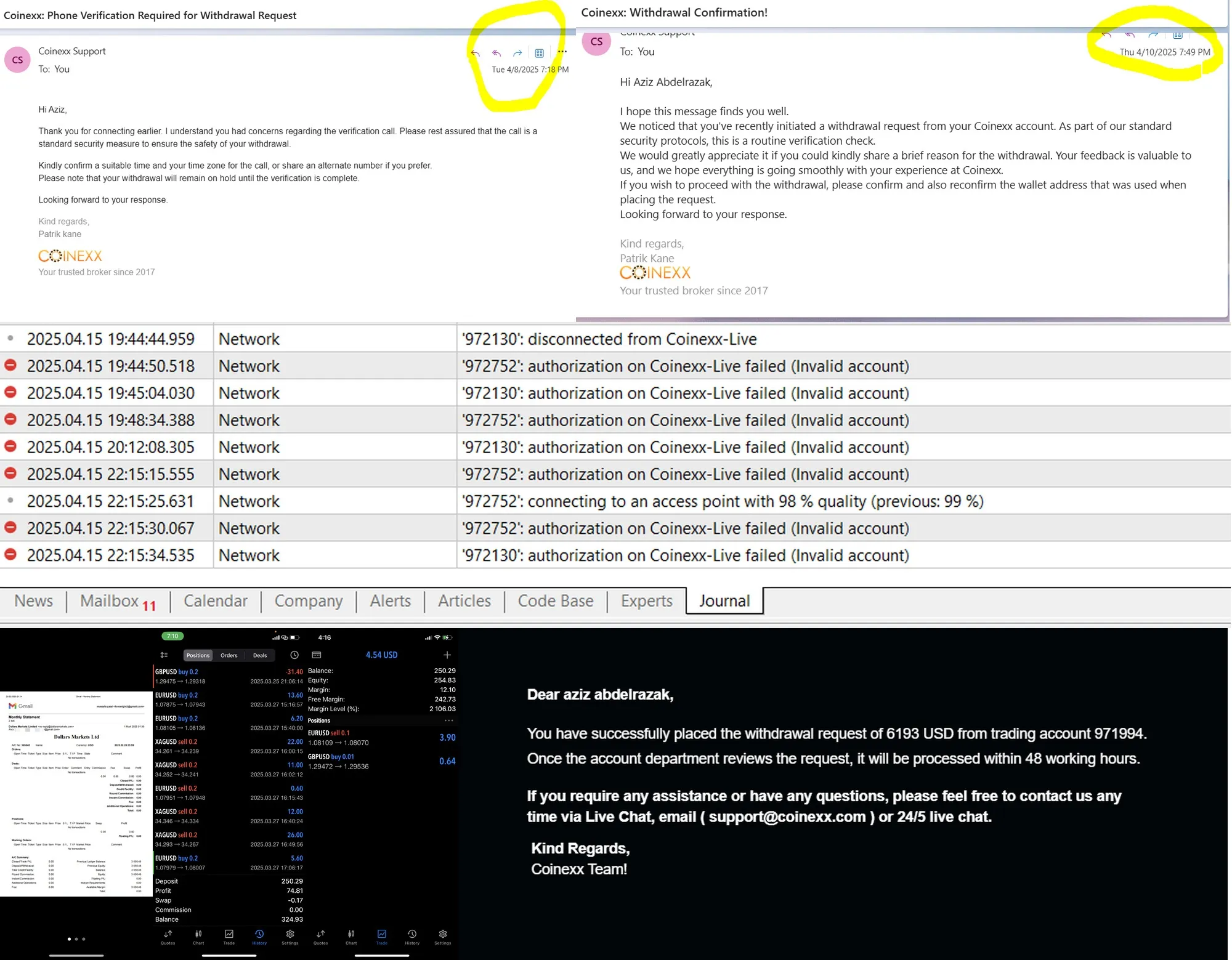
A Canada case dated October 12, 2024, written in Chinese, describes a user depositing more than $60,000 on a platform referred to in the text as “Coinmte.” The user said small withdrawals initially worked, but after making more than $60,000 in profit, a larger withdrawal failed and the account was frozen. The case further claims the platform accused the user and 28 other accounts of insider trading, then demanded a $29,635 margin payment and later another $36,735 penalty before unfreezing the account. The user said more than $90,000 could not be withdrawn.
A Venezuela case dated April 4, 2024, translated from Spanish, says the user invested money, was later told to invest more in order to withdraw, and then could not add more because the first investment had been funded with borrowed money. The user still had platform access but said the withdrawal was shown as pending verification.
These cases do not prove every user will face the same outcome, but they point to a pattern you should not ignore: withdrawal friction, account freezing or blocking, and requests for additional payments before funds are released.
Deposits, Withdrawals, and Support
Customer service is listed with English-language channels including Facebook, two phone numbers, two email addresses, Instagram, and YouTube. The source says users can contact support by phone, email, and instant messaging software and may receive most relevant answers, although waiting times may be long.
That support note matters because several exposure cases involve delayed or generic responses. If you are already using the broker, keep all communication records, save screenshots of withdrawal requests, and avoid sending additional money solely because support claims it is required to unlock funds.
Final Verdict: Should I open an account?
Based on the supplied WikiFX data, COINEXX is a high-risk broker choice. The broker offers MT4/MT5, an ECN account, low minimum deposit conditions, and access to Forex, commodities, indices, and cryptos, but those trading features do not offset the absence of verified regulation, the low WikiFX Score of 2.33, and multiple complaint cases involving withdrawals and account access.
If you are considering COINEXX, do not rely only on advertised spreads or platform familiarity. Start with a small risk assessment: check regulation first, verify the website carefully, document every deposit and withdrawal step, and avoid depositing funds you cannot afford to have tied up.
Status changes daily. Before depositing, check the WikiFX App for the latest real-time certificate.

Disclaimer:
The views in this article only represent the author's personal views, and do not constitute investment advice on this platform. This platform does not guarantee the accuracy, completeness and timeliness of the information in the article, and will not be liable for any loss caused by the use of or reliance on the information in the article.
WikiFX Broker
Latest News
EURUSD | Demand Zone Holding, Bulls Eyeing Higher Resistance
WikiFXKudotrade Review 2026: Reported Slippage & Trade Execution Issues You Should Know
WikiFXEUR/USD: Bearish Structure Shift
WikiFXOROKU EDGE Review 2026: What Traders Should Know About Withdrawal & Slippage Reports
WikiFXFxPro Opens Five CFDs To Weekend Trading
WikiFXMalaysia To Host Asia Fintech Regulatory Summit
WikiFXIG Faces Hundreds Of Job Cuts In Global Restructure
WikiFXSEC Alleges $16 Million Ponzi Scheme Targeted 200 Investors
WikiFXWeekend CFD Trading Moves Beyond Gold as Brokers Add Oil, Silver and Indices
WikiFXValutrades Rejects Exit Rumors Amid Client Review
WikiFX