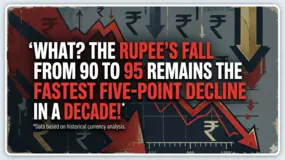
Abstract:The rupee bounced to 95.20 but RBI's forex reserves took a brutal $8.1 billion hit in a single week — here is what every Indian investor needs to understand right now.
The Rupee Bounced — But Don't Start the Celebrations Yet
So the rupee jumped 40 paise to 95.20 against the dollar, and suddenly every WhatsApp uncle is forwarding 'India is back, bhai' voice notes. Calm down. Yes, USD/INR has been falling for four straight sessions, which sounds great until you remember that just a few months ago, we were sitting comfortably near 84. That is a 14% depreciation in one of the world's fastest-growing economies. The recent bounce? Partly driven by hopes of an Iran-US ceasefire, which is — let's be honest — one of the most fragile reasons to feel good about your currency. Peace deals in the Middle East have the shelf life of a Mumbai vada pav left in the sun.
RBI's $8 Billion Week — The Most Expensive Defence Since Panipat
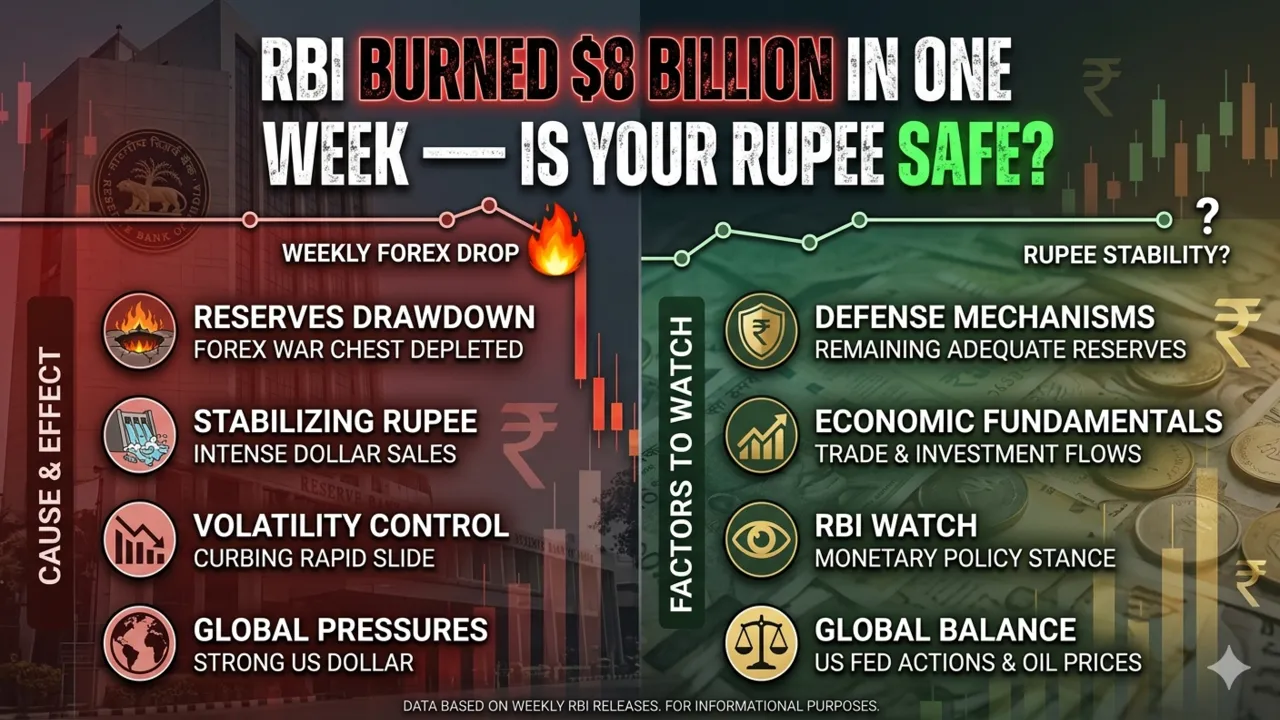
Here is the number that should make you put down your chai: India's forex reserves dropped $8.1 billion in a single week, landing at $688.9 billion. The RBI was out there in the open market, selling dollars aggressively to stop the rupee from going into full free-fall mode. Now, the official spin is reassuring — the RBI has only spent about 2% of its total forex hoard defending the rupee so far. That sounds fine until you do the maths. Peak reserves were $704 billion back in September 2024. We have already shed roughly $15 billion since then. At the current rate of weekly burns, this drip bag starts looking worrisome, by the way. Foreign investors watch that reserve number the same way a nervous patient watches an IV bag in the ICU.
The Governor Said 'Undervalued' — Read Between the Lines
RBI Governor Sanjay Malhotra dropped a quiet but significant remark in an interview with Mint, suggesting the rupee may actually be 'undervalued' following its recent depreciation. Now, central bankers do not say things like this by accident. This is the monetary policy equivalent of a cricket captain winking at the pitch report. What it signals is that the RBI may be willing to let the rupee find a higher level — meaning less aggressive intervention going forward — and that the current weakness is not entirely a disaster in their view. For exporters, this is music. For anyone importing crude oil, machinery, or electronics, this is a very different song — more like a funeral march.
The Triple Threat: Oil, FIIs, and the Current Account Deficit
Let us talk about why the rupee was under such pressure in the first place, because this is not a one-villain story. First, Brent crude has been sitting uncomfortably high, and with the Hormuz crisis adding freight and risk premiums, India's import bill in dollar terms is going up every single day while the rupee buys fewer of those dollars — a classic double jhatka. Second, FIIs pulled out over Rs 35,000 crore from Indian equities in Q1 FY26 alone. Every time a foreign fund manager hits 'sell' on his Nifty ETF, those rupees get converted back to dollars and leave the country. Third, India's current account deficit for Q3 FY26 came in at $17.8 billion — that is a structural hole that needs to be filled with either exports, FDI, or borrowed money. None of those solutions is instant.
What the Smart Money is Actually Doing Right Now
Here is the funda that most retail investors miss completely. While everyone is debating whether the rupee will go back to 84 or crash to 100, the people who actually understand macro are quietly doing two things. One, they are accumulating USD-denominated assets — US ETFs, international mutual funds, anything that gives them dollar exposure within the RBI's Liberalised Remittance Scheme limit of $250,000 per year. Two, they are watching FDI numbers carefully, because FDI into India actually rose sharply in FY26, which tells you that long-term confidence in the India story is still intact even if short-term speculators are nervous. The RBI has also been running forex swap operations, selling dollars in the spot market, and managing liquidity — multiple tools, not just one lever.
The Bottom Line: Bullish Bounce or Borrowed Time?
Look, the rupee at 95.20 is better than the rupee at 96.50, and the market sentiment is cautiously bullish right now. The Iran-US ceasefire hopes, a slightly softer dollar globally, and the RBI's active management have all combined to give the currency some breathing room. But the structural pressures — high crude, FII outflows, a chunky current account deficit, and a global environment where the dollar remains king — have not gone away. The RBI cannot sell dollars forever; at some point, the intervention becomes the story itself and spooks the very investors you are trying to attract. So protect your wealth, hedge your dollar exposure, and for the love of everything sacred, please stop trusting that Telegram channel that told you USD/INR was going to 80 by December. That guy seems to be a fraud, and the macro data does not lie.
标签:#RupeeRebound #ForexIndia #RBIIntervention #USDINR #ForexReserves #IndianEconomy #DalalStreet #RBIAlert
Download the WikiFX App for the latest forex updates

More Interesting Articles for You
ECN vs STP Forex Brokers: A Complete 2026 Comparison
If you've spent any time researching forex brokers, you've almost certainly run into the labels ECN and STP. They sound technical, broker marketing departments use them interchangeably, and the actual difference matters more for your trading costs than most beginners realize.
Both ECN and STP are No Dealing Desk (NDD) execution models — neither broker type takes the opposite side of your trade. That alone separates them from market makers and matters because it removes a fundamental conflict of interest. But the way each model routes your order, prices it, and earns revenue is structurally different, and those differences directly translate into the spread you pay, the slippage you absorb, and whether your strategy is profitable at scale.
This guide breaks down exactly how the two models work, where they diverge, and which one fits which type of trader.
News
2026-05-20
Further Reading