

Global Broker Regulation Inquiry App
About WikiFX
English
简体中文
繁體中文
English
Pусский
日本語
ภาษาไทย
Tiếng Việt
Bahasa Indonesia
Español
हिन्दी
Filippiiniläinen
Français
Deutsch
Português
Türkçe
한국어
العربية
اردو


naqdi Review 2026: Is this Forex Broker Legit or a Scam?

WikiFX
|


Abstract:naqdi is a South Africa-based broker regulated by the FSCA, offering the popular MT5 platform and leverage up to 1:500. However, despite possessing a valid license, severe and recent user complaints regarding blocked withdrawals and hidden fees make it a high-risk option for traders.

naqdi Review 2026: Is this Forex Broker Legit or a Scam?
Executive Summary (TL;DR): naqdi is a moderately established broker regulated in South Africa, offering high leverage and access to the MT5 platform. However, numerous recent reports of frozen accounts and blocked withdrawals strongly contradict its legitimate regulatory front, earning it an average WikiFX Score of 6.11.
Before you commit your hard-earned capital to any financial institution, you need absolute certainty that your funds are safe. If you are searching for a reliable broker, naqdi might have populated your search results due to its aggressive marketing in the Middle East and beyond. In this comprehensive naqdi review, we will break down the data to see if this company is a trustworthy partner or a potential trap for your capital. Currently holding a WikiFX score of 6.11 out of 10, naqdi presents a very mixed picture. Let us explore why.
Question 1: naqdi Regulation & Safety: Is my money safe?
When you trade Forex, naqdi requires you to deposit real money, which means their legal standing is the single most critical factor to examine. Fortunately, naqdi is not essentially an unregulated offshore phantom. The company (operating legally as Naqdi Group (PTY) LTD) is monitored by the South African Financial Sector Conduct Authority (FSCA) under license number 51598.
But what does this naqdi regulation status actually mean for you as a retail trader?
The South African FSCA is widely considered a “Tier-2” regulator. It is significantly safer than unregulated island nations (like St. Vincent and the Grenadines), but it is not as aggressively protective as Tier-1 authorities like the US SEC or the UK's FCA.
Educational Context: One of the most vital concepts in broker safety is “Segregated Accounts.” Under strict Tier-1 guidelines, a broker legally cannot mix your deposit with their own operational money. If the broker goes bankrupt, your money is theoretically safe in a separate bank tier. While FSCA enforces general fairness and operational audits, offshore clients registering under the South African branch may not always receive the same ironclad compensation scheme protection as European citizens do in their local jurisdictions. Always verify your specific naqdi regulation coverage in the client agreement.
Question 2: Are the trading fees and leverage fair?
naqdi operates a tiered account system—Elite, Premier, and Standard—catering to different deposit thresholds.
- Elite Account: Spreads from 0.0 pips.
- Premier Account: Spreads from 0.9 pips.
- Standard Account: Spreads from 1.4 pips.
All account tiers offer a maximum leverage of 1:500.
Educational Context: High leverage is heavily heavily marketed, but it is a notorious double-edged sword. A 1:500 leverage means you can control $500 in the market for every $1 you deposit. While this dramatically lowers the barrier to entry for Forex naqdi trading costs, it also vastly amplifies your risk. With 1:500 leverage, a mere 0.2% price movement against your position will result in a margin call, potentially wiping out your account instantly. Novice traders must exercise extreme caution.
Question 3: What are real traders complaining about?
This is where the polished exterior of naqdi begins to severely crack. Within just a recent 3-month window, the WikiFX database highlights 4 severe formal complaints against this broker.
Let's look at the actual evidence:
- The UAE Crisis (November 2025): A trader from the United Arab Emirates reported a chilling scenario: “thy are bankrupt, thy didnt give withdrawal past 4 months.” The user further claims that internal employees are quitting due to terrible management practices.
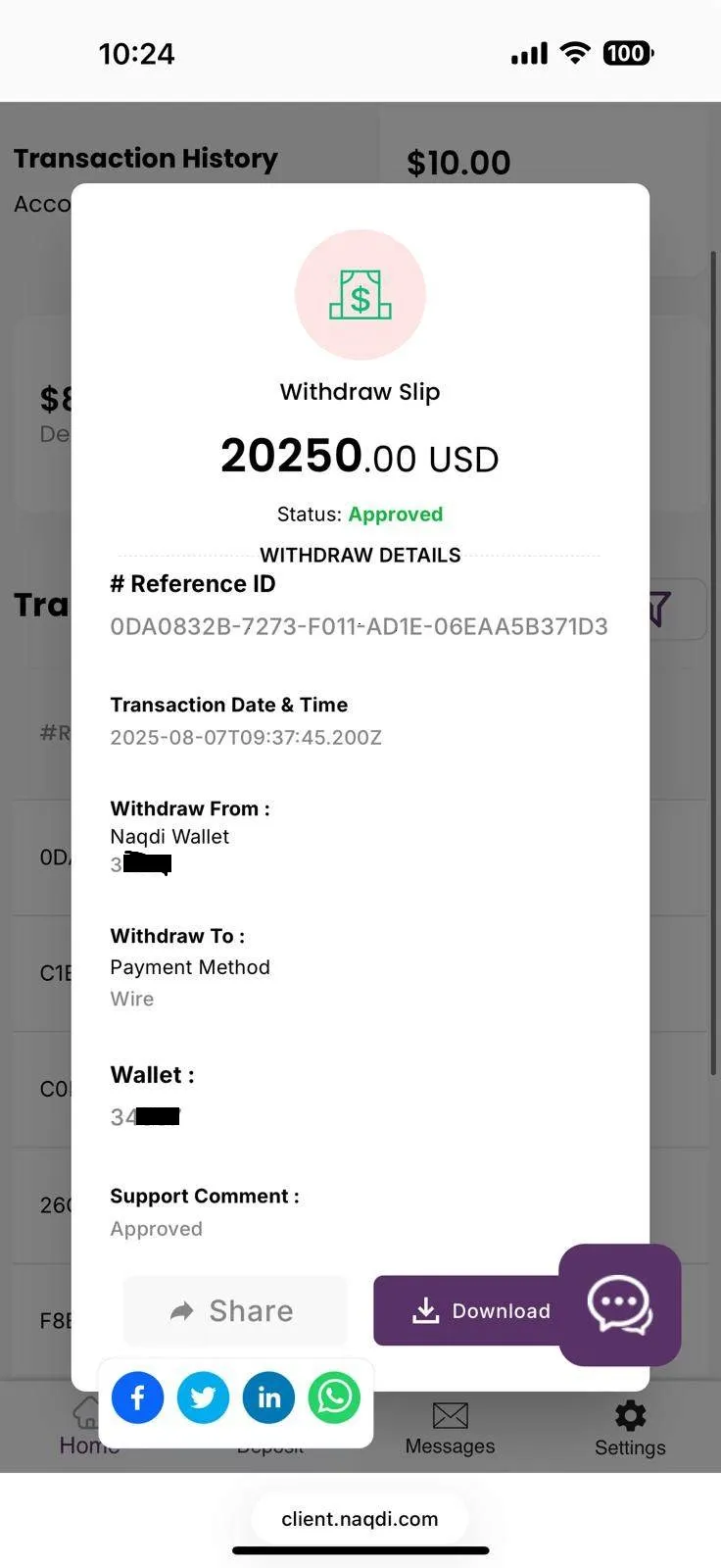
- The Russian Crypto Trap (October 2024): Another client deposited $300 via the Tron crypto network after being pressured by aggressive sales tactics. They were promised zero commissions on Bitcoin/USD trades, which turned out to be false. Worse, when attempting a withdrawal, the broker claimed processing issues and failed to provide a valid blockchain transaction hash after 4 days. Execution times on trades were also reported to be lagging by a massive “1.5 seconds”.
Pro Tip: Pay close attention to the second complaint. Funding your account via cryptocurrency (like Tron/USDT) eliminates your ability to initiate a traditional bank chargeback if the broker refuses to pay you. If a heavily-complained broker insists on crypto deposits, consider it a massive red flag for incoming withdrawal delays.
Question 4: What software will I use?
Traders at naqdi utilize the industry-standard MetaTrader 5 (MT5) platform. MT5 is a fantastic, highly customizable software suite that allows for algorithmic trading (Expert Advisors), deep market depth analysis, and robust charting tools. However, naqdi specifically fails on several modern security implementations.
According to technical reviews, their platform integration currently lacks essential features such as two-factor authentication (2FA) and biometric login capabilities.
Educational Context: Because MT5 does not govern the broker's underlying servers—it is merely a user interface—it cannot protect your account from targeted hacks if the broker's own portal security is weak. Always ensure you are on the official company site before entering your naqdi login details to avoid phishing scams. A compromised naqdi login without 2FA protection means a hacker could easily breach your account and execute malicious trades to drain your balance.
Final Verdict: Should I open an account?
While naqdi holds a verified regulatory license with South Africa's FSCA and offers the robust MT5 trading platform, it represents an incredibly high-risk environment. The frightening nature of the real-world complaints—specifically the four-month withdrawal lockouts, alleged bankruptcy rumors, and deceptive fee structures—completely overshadows its regulatory compliance. High leverage (1:500) combined with 1.5-second execution delays is a recipe for catastrophic trading losses.
We strongly advise you to exercise maximum caution. Status changes daily in the Forex world. Before depositing any funds, check the WikiFX App for the latest real-time certificates, live user complaints, and updated scoring data on naqdi.

Disclaimer:
The views in this article only represent the author's personal views, and do not constitute investment advice on this platform. This platform does not guarantee the accuracy, completeness and timeliness of the information in the article, and will not be liable for any loss caused by the use of or reliance on the information in the article.
WikiFX Broker
Latest News
U.S. Dollar Moves Away From Session Highs As Treasury Yields Drop: Analysis For EUR/USD, GBP/USD, USD/CAD, USD/JPY
WikiFXRBI Tightens Rupee Derivative Rules as Currency Hovers Near Record Low
WikiFX92 Claims, No Sources: The Trump Scorecard Line That Touches India
WikiFXRupee Fell to ₹97, Clawed Back to ₹94.5 — The $15.4 billion Oil Bill is Still There
WikiFXMan Sells His House to Invest, Only to Lose RM132,590 in Forex Scam
WikiFXEMAR MARKETS Review: What Traders Should Know Before Depositing
WikiFXOtetMarkets Review 2026: Reported Account Block, Bonus Abuse & Withdrawal Delay Claims
WikiFXXTrend Speed Broker Exposed: What Are Other Traders Saying About This Broker?
WikiFXXTrend Speed Broker Review: Is It Safe for Traders?
WikiFXAs Europe’s Cost-of-Living Crisis Flares, Far Right Gains Ground Ahead of Elections
WikiFX