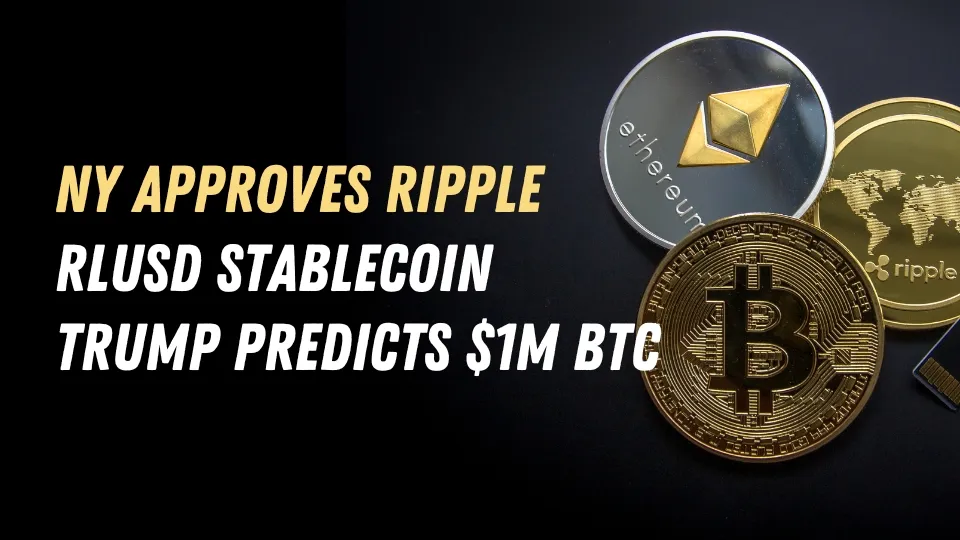
Abstract:New York approves Ripple's RLUSD stablecoin, Eric Trump predicts Bitcoin’s rise to $1M, and Google unveils a quantum chip that could impact crypto encryption.
 Contents
NYDFS Approves Ripple's RLUSD Stablecoin
Ripple Labs CEO Brad Garlinghouse revealed that the New York Department of Financial Services (NYDFS) has approved the RLUSD stablecoin. The statement was made in a December 10 social media post by Garlinghouse, who indicated that Ripple will shortly release exchange listings for RLUSD.
RLUSD, which debuted in April, is intended to compete with top dollar-pegged stablecoins such as Tether (USDT) and USD Coin (USDC). Ripple launched its testing phase in August, using both the XRP ledger and the Ethereum mainnet. This action establishes RLUSD as a formidable player in the expanding stablecoin industry, which is expected to rise to $2 trillion in the next four years from its current $207 billion.
Eric Trump Predicts Bitcoin Will Reach $1 Million
On December 10, during the Bitcoin MENA event in Abu Dhabi, Eric Trump, executive vice president of the Trump Organization, presented his bullish outlook on Bitcoin (BTC). Trump predicted that Bitcoin would one day reach $1 million per coin and complimented its unique status as a worldwide financial instrument.

Trump referred to Bitcoin as more than simply digital money. He described Bitcoin as a “store of value” that protects against inflation and political instability. He firmly predicted that additional countries would ultimately accept Bitcoin, with early investors standing to earn the most from its development.
Google's New Quantum Chip and Its Potential Impact on Crypto
In a daring step, Google's Quantum AI team announced a new quantum computer hardware that has the potential to transform the landscape of Bitcoin encryption. This technical development has raised questions about the future of existing cryptographic security mechanisms employed in blockchain and cryptocurrency systems.
The advent of quantum computing opens up new opportunities for quicker computations, but it also poses significant concerns, such as the capacity to overcome existing encryption algorithms used to secure digital assets. This new finding accelerates current attempts to enhance quantum-resistant encryption in the crypto arena.
Final Thoughts
The certification of Ripple's RLUSD stablecoin is a significant milestone for the cryptocurrency sector, indicating stablecoins' expanding prominence in global banking. Meanwhile, Eric Trump's bold Bitcoin projections reflect the growing general acceptance of cryptocurrencies as a significant asset class. Finally, as Google's quantum computing chip approaches reality, the future of crypto encryption may confront new problems, forcing the industry to adapt quickly in the face of developing technology. The cryptocurrency market is always changing, and staying ahead of the curve will be critical for both investors and companies.