


OANDA Review 2026 for India
OANDA review for India covering global regulation, RBI forex rules, OANDA login security, platforms and regulatory history.
Original

简体中文
繁體中文
English
Pусский
日本語
ภาษาไทย
Tiếng Việt
Bahasa Indonesia
Español
हिन्दी
Filippiiniläinen
Français
Deutsch
Português
Türkçe
한국어
العربية
اردو




Abstract:CFTC fines Nasdaq Futures $22M for providing misleading info and violating Core Principles. This penalty underscores the importance of transparency in financial markets.
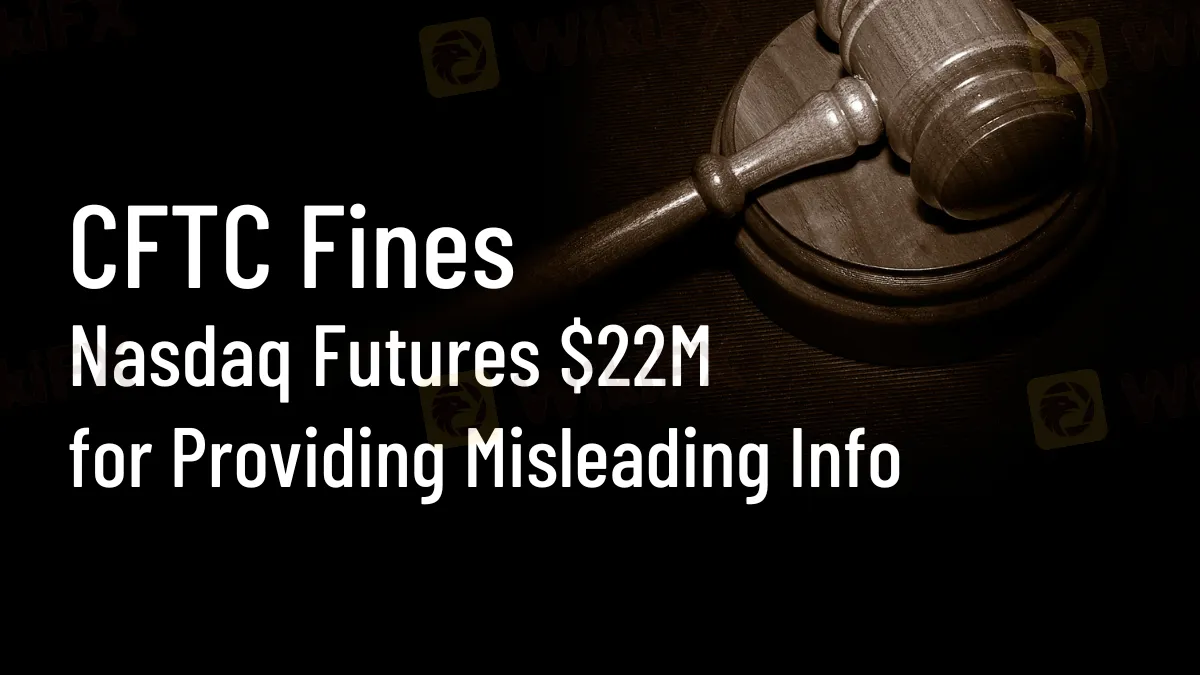
Washington, DC - The Commodity Futures Trading Commission (CFTC) fined Nasdaq Futures, Inc. $22 million, a former designated contract market (DCM). The penalty is the result of the company's failure to disclose important data about its incentive programs to both the CFTC and the public, as well as submitting incorrect and misleading information to the regulatory body. This fine emphasizes the CFTC's strict regulation of market activities as well as the value of openness in the financial sector.
 Contents
The CFTC's inquiry showed that Nasdaq Futures, Inc. failed to create, monitor, or enforce regulations governing an incentive program given to select traders on its platform. The Commodity Exchange Act (CEA) requires DCMs, such as Nasdaq Futures, to follow specified Core Principles aimed at maintaining market integrity and safeguarding participants. Among these principles is the duty to provide the CFTC, market participants, and the general public with accurate and full information.
Nasdaq Futures, Inc. failed in this respect by failing to disclose all aspects of its incentive scheme. In particular, the business did not notify the CFTC about a volume-based component of its “Designated Market Maker” (DMM) program. This component provides extra payouts to specific participants depending on the overall amount of contracts exchanged, a critical fact that was concealed in CFTC communications.
Nasdaq Futures, Inc., was a DCM that specialized in energy commodity futures contracts between July 2015 and July 2018. During this time, the business launched a number of incentive schemes, including the DMM program, which paid a set monthly stipend to market makers to boost market liquidity. However, the CFTC was purposely kept unaware of the existence of a volume-based incentive inside this scheme.

According to the CFTC's ruling, Nasdaq Futures, Inc. provided incorrect and misleading information concerning the DMM program. When questioned by CFTC officials, workers consistently denied the existence of volume-based incentives despite the fact that such payments were given to some program participants. These practices violated the CEA and undercut the CFTC's expectation of trust and openness from regulated firms.
The CFTC's ruling also cited Nasdaq Futures, Inc.'s failure to follow regulatory service provider guidelines. The corporation was instructed to contact three DMM program members about a particular trading activity, but it did not do so and did not record the reasons for its decision. This lapse added to the breaches of other DCM Core Principles.
CFTC Director of Enforcement Ian McGinley underscored the gravity of the infractions, adding, “The CFTC's oversight regime is dependent on CFTC-designated exchanges providing accurate information to the CFTC and market participants.” Nasdaq Futures, Inc.'s actions here constitute severe breaches of both its responsibility to furnish such information and multiple statutory Core Principles applicable to CFTC-designated exchanges.
The $22 million civil monetary penalty issued on Nasdaq Futures, Inc. exemplifies the repercussions of failing to comply with regulatory standards. The CFTC's action emphasizes the significance of openness and correct reporting in ensuring market stability.
This case is keenly watched by the financial sector, as it demonstrates the CFTC's commitment to holding corporations accountable for their activities. The penalties also send a strong message to all market players about the necessity of complying with regulatory requirements and the consequences of non-compliance.
The CFTC expressed gratitude to the National Futures Association for their help in this instance. Brett Shanks, Elsie Robinson, Jeff Le Riche, Brandon Wozniak, Margaret Aisenbrey, Jordon Grimm, Christopher Reed, Charles Marvine, and former Division of Enforcement employee Jo Mettenburg were all engaged in this case.
Nasdaq Futures, Inc. received a $22 million penalty for failing to disclose critical information and making deceptive representations to the CFTC. This case emphasizes the crucial necessity of regulatory compliance and openness in financial markets and confirms the CFTC's responsibility to ensure market stability.
Stay updated on this and other financial news by visiting our WikiFX news page for the latest updates and in-depth coverage.

Disclaimer:
The views in this article only represent the author's personal views, and do not constitute investment advice on this platform. This platform does not guarantee the accuracy, completeness and timeliness of the information in the article, and will not be liable for any loss caused by the use of or reliance on the information in the article.

OANDA review for India covering global regulation, RBI forex rules, OANDA login security, platforms and regulatory history.
This TPFx review examines PT Trijaya Pratama Futures, Broker Code 4461810512, its Bappebti record, the Q1 2026 A+++ assessment, look-alike website warning, product costs, withdrawals and complaint route for traders researching an Indonesia forex broker.
The Fed releases the July FOMC minutes on 19 August 2026. Here are three USD and gold scenarios, confirmation signals, and a practical risk checklist for traders.
Angel One, an India-based brokerage entity, constantly receives allegations from users online. Users are complaining about withheld funds, poor customer support service, undesired trade execution orders, etc. In this Angel One review, let’s quickly go through these complaints, understand its regulatory framework and pay attention to the product portfolio.
WikiFXWikiFXWikiFXWikiFXWikiFXWikiFXWikiFXWikiFXWikiFXWikiFX