


India Q1 FY27 GDP Growth Hits 7.8%: 3 Scenarios for INR and Gold
India's Q1 FY27 GDP grew 7.8%, beating a 7.4% poll and RBI's 7.0% projection. See three conditional scenarios for INR, rates and gold.
Original

简体中文
繁體中文
English
Pусский
日本語
ภาษาไทย
Tiếng Việt
Bahasa Indonesia
Español
हिन्दी
Filippiiniläinen
Français
Deutsch
Português
Türkçe
한국어
العربية
اردو




Abstract:Is a stop loss truly necessary? "Yes," is the fast answer. "Yes, if you choose not to blow up your Forex trading account," is the extended version of the response. There are a variety of reasons to use a stop loss, but there are several tactics that may be used to avoid using one, albeit doing so is normally reserved for institutional traders.
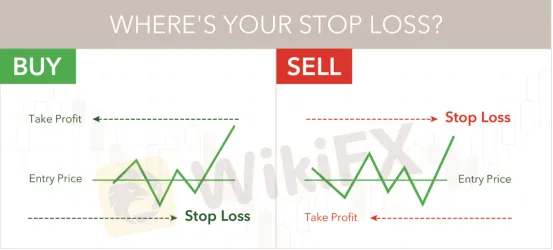
Is a stop loss truly necessary? “Yes,” is the fast answer. “Yes, if you choose not to blow up your Forex trading account,” is the extended version of the response. There are a variety of reasons to use a stop loss, but there are several tactics that may be used to avoid using one, albeit doing so is normally reserved for institutional traders.
Your best buddy is the stop loss.
Because currency markets can become volatile at any time, the stop loss is your best friend. There may be a surprise announcement, an event taking place halfway over the world, or, worst of all, something happening while you are sleeping. Because you can't forecast everything that will happen, the stop loss serves as your guardian angel. When it comes to the Forex markets, there are a slew of reasons why you can observe a price surge.
For example, the Swiss National Bank has defended the 1.20 level in the EUR/CHF pair in recent years, refusing to allow the pair to go below that level since the Swiss franc had become far too costly. The SNB, however, abruptly abandoned the peg on January 15, 2005, allowing the market to fall since they had been guarding that level for a couple of years and it had now become too expensive. Because it was “easy money,” large sums of institutional money poured in and bought the pair whenever it approached the 1.20 level. The pair, however, crashed and plunged several candles in milliseconds as soon as the Swiss moved away from the currency markets.There were examples all around the world of retail traders who were wiped out because they failed to exercise basic sense and put in a stop loss.
Consider yourself an American merchant. You held a EUR/USD trade and relied on the Swiss National Bank to safeguard you. On January 15, you wake up to find that your bank account is empty. Your broker is wanting more margin, and for other clients, it was much worse: they owed money to their brokers because orders were not being processed quickly enough.
Granted, this is an extreme case, but it is not uncommon for a pair like the GBP/JPY to drop 120 pips while you sleep. Stop loss is sometimes referred to as a “disaster stop,” but it's actually meant to protect you when your analysis is inaccurate, and let's face it, erroneous analysis is a part of the game.
There's a reason why stop losses exist.
Stop losses are not only in place to safeguard your account from disaster, but they also serve as a “line in the sand” for when your analysis is shown to be inaccurate. If it turns out to be erroneous, you just depart the market and recognize that you have another day to battle.
Unfortunately, far too many of you will move stop losses to prevent losing money, but a good trader is prepared to cut losses promptly. Finally, a smart trader realizes that if your analysis is shown to be erroneous, it is preferable to limit your losses. Moving your stop loss in your favor to lock in winnings is a totally fair approach if your analysis is confirmed to be the correct analysis. This allows the market to warn you when it's time to exit after a significant gain.
Never trade without a stop loss in place.
Under no circumstances should you trade without a stop loss. You might lose a lot of money for a variety of reasons. Granted, some of the arguments I've made in this essay are a little exaggerated, but at the end of the day, you never know when something unexpected will occur. It's also a means to force your account back to neutral if the deal doesn't work out. You may even utilize it to benefit if the market reverses course after a large rise in your favor.
People who felt they were wiser than the market and couldn't be bothered to take a loss are scattered across the Forex sector. Other than reducing your losses and building on your winnings, there is no such thing as a “100% effective approach.” Losses are unavoidable, therefore the only thing you can do is protect yourself.

Disclaimer:
The views in this article only represent the author's personal views, and do not constitute investment advice on this platform. This platform does not guarantee the accuracy, completeness and timeliness of the information in the article, and will not be liable for any loss caused by the use of or reliance on the information in the article.
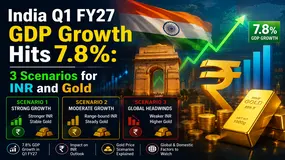
India's Q1 FY27 GDP grew 7.8%, beating a 7.4% poll and RBI's 7.0% projection. See three conditional scenarios for INR, rates and gold.
Did you encounter trade-related concerns with Tattvam, a Mauritius-based brokerage entity? Several users have reportedly accused the broker of cancelling profitable trades, allegedly citing scalping as the reason. At the same time, traders have reportedly expressed concerns over the lack of understanding among the broker officials about critical trading aspects such as copy trading. In this Tattvam review, we have carefully examined user-reported allegations. Additionally, we have given a regulatory overview of the broker.

Choosing a forex liquidity provider is not a search for the lowest displayed spread or the longest provider list. It is a broker decision about pricing integrity, depth, routing, credit, reporting, incident response, and client communication. This 2026 guide explains how a forex LP, FX liquidity provider, or liquidity provider forex arrangement fits into a broker’s execution chain; what to test before onboarding; why a “best forex liquidity provider” claim cannot replace due diligence; and how to compare cost beyond commission. Use the execution-quality scorecard, provider questions, routing scenarios, and 90-day onboarding plan to assess whether a liquidity relationship can support your actual client mix, instruments, risk model, and jurisdiction. The goal is not to make a universal ranking. It is to build evidence that your broker can explain, supervise, reconcile, and recover its execution service when market conditions are difficult.
The visible fee in an MT4 white label proposal is rarely the real cost of operating it. For an existing broker, the decision is not simply whether an MT4 white label platform is “cheap” or “expensive.” The real question is whether the commercial model remains viable after integration, support, data, client migration, compliance, and exit costs are included. That is why an MT4 white label cost review should be built as a 24- to 36-month operating case. It should compare three credible choices: 1. Keep the present MT4 setup and improve its weakest controls. 2. Replace the MT4 white label provider but retain the client proposition. 3. Migrate selected clients or products to another platform while running MT4 in parallel. This guide explains how to build that case without relying on headline prices or generic vendor claims.
WikiFXWikiFXWikiFXWikiFXWikiFXWikiFXWikiFXWikiFXWikiFXWikiFX