

عالمی بروکر ریگولیشن چیک کرنے والا ایپ
WikiFX
اردو
简体中文
繁體中文
English
Pусский
日本語
ภาษาไทย
Tiếng Việt
Bahasa Indonesia
Español
हिन्दी
Filippiiniläinen
Français
Deutsch
Português
Türkçe
한국어
العربية
اردو


UPI 0.4% MDR Kicks in October 15: Who Pays, Who's Exempt, and Why Your Kirana Bill May Still Rise

WikiFX
|


خلاصہ:The National Payments Corporation of India (NPCI) has introduced a 0.4% Merchant Discount Rate (MDR) on person-to-merchant UPI payments above ₹2,000, effective October 15, 2026. The fee is capped at ₹300 for transactions of ₹75,000 and above. Person-to-person transfers remain free, and small merchants receiving up to ₹1 lakh a month through UPI QR codes stay exempt. The Finance Ministry notified on September 14–15 that banks cannot charge users on UPI transactions up to ₹2,000 or on RuPay debit-card payments. NPCI then announced the MDR framework. Essential sectors — fuel, railways, telecom, insurance, agriculture inputs — will pay a flat ₹5 per transaction above ₹2,000. Payments for mutual funds, securities, stock brokers and dealers attract a reduced MDR of 0.02%, capped at ₹300. Officials have been categorical: the customer will not be charged. The Ministry of Finance said banks have been advised to ensure merchants do not pass on the MDR to customers. But the post that triggered
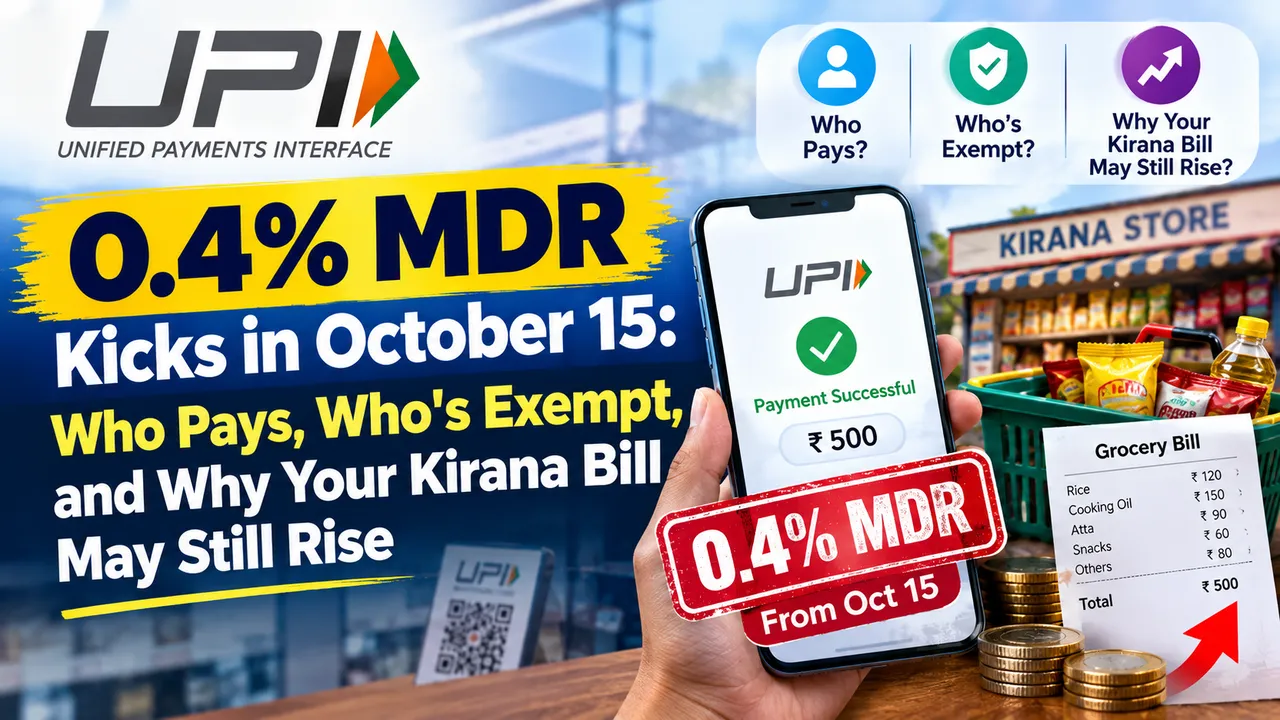
The National Payments Corporation of India (NPCI) has introduced a 0.4% Merchant Discount Rate (MDR) on person-to-merchant UPI payments above ₹2,000, effective October 15, 2026. The fee is capped at ₹300 for transactions of ₹75,000 and above. Person-to-person transfers remain free, and small merchants receiving up to ₹1 lakh a month through UPI QR codes stay exempt.
The Finance Ministry notified on September 14–15 that banks cannot charge users on UPI transactions up to ₹2,000 or on RuPay debit-card payments. NPCI then announced the MDR framework. Essential sectors — fuel, railways, telecom, insurance, agriculture inputs — will pay a flat ₹5 per transaction above ₹2,000. Payments for mutual funds, securities, stock brokers and dealers attract a reduced MDR of 0.02%, capped at ₹300.
Officials have been categorical: the customer will not be charged. The Ministry of Finance said banks have been advised to ensure merchants do not pass on the MDR to customers. But the post that triggered this debate — from does not absorb a new cost out of civic duty. He recovers it.
 فہرست
فہرستWhat Exactly Changes on October 15
The MDR applies only to person-to-merchant (P2M) UPI transactions above ₹2,000. Below that, nothing changes. The government says only 4% of merchant transactions will be impacted, since most fall under the threshold.
Here's the breakdown:
- P2P transfers : Free, regardless of amount. The Finance Ministry says P2P transactions constitute 37% of UPI volume and 70% of value.
- P2M up to ₹2,000 : Free.
- P2M above ₹2,000 : 0.4% MDR, capped at ₹300 for transactions of ₹75,000 and above.
- Small merchants (P2PM) : Those receiving up to ₹1 lakh per month via UPI QR codes pay zero MDR.
- Essential sectors : Flat ₹5 per transaction above ₹2,000 for fuel, railways, telecom, insurance, agriculture inputs.
- Financial market payments : 0.02% MDR for mutual funds, securities, stock brokers, capped at ₹300.
The MDR is “shared amongst the payment ecosystem partners, including banks and app providers,” the Finance Ministry said. It's not a fee on the consumer — it's a fee on the merchant, paid to the bank or payment processor.
Why This Fee Exists
UPI has run on a zero-MDR model since its launch. Banks and payment firms have argued for years that this is unsustainable. The Payments Council of India (PCI) chairman Vishwas Patel told CNBC-TV18 that the new charges help banks and payment companies recover part of the costs of building and maintaining India's digital payments infrastructure. “MDR is not to create a profit pool for players,” PCI said, calling the charge the “bare minimum” needed to sustain the network.
Patel also clarified that RuPay debit cards — 800 million of them — remain free of MDR. “Consumers are not paying for anything,” he said. “95% of the transactions are below ₹2,000. Those are still free.”
The Finance Ministry framed the move as making UPI “self-sustainable” while keeping most payments free. “The new MDR framework will make UPI self-sustainable, give incentives for further expansion in rural and semi-urban areas and maintain competitiveness,” it said.
The Whistleblower's Counter: The Fee Will Land on Your Bill
The
His core claim: official instructions not to pass on the cost are “easy to write and hard to police.” A shopkeeper with thin margins won't absorb a new cost out of civic duty. He'll recover it — by raising prices. If even part of that 0.4% is folded into prices, inflation will do what no gazette notification can prevent.
The post has almost no engagement — 1 like, 1 repost, 0 comments. But it captures a sentiment that's circulating in Indian households: that every reform eventually becomes a collection window. “Has the Center become a recovery government,” Singh asks, “inventing new rules, under new names, to fill the system's coffers while calling it sustainability?”
What the Reports Say — and Where They Diverge
The Hindu, Times of India, India Today, CNBC-TV18 and entrackr all reported the MDR framework. They agree on the core numbers: 0.4% above ₹2,000, ₹300 cap, October 15 effective date, small merchant exemption, flat ₹5 for essential sectors.
But there's a notable discrepancy on the RuPay debit card. India Today reported that the Finance Ministry's notification “specified UPI transactions of up to Rs 2,000 and RuPay-powered debit cards as electronic payment modes on which direct or indirect charges cannot be imposed.” That suggests RuPay debit cards are protected up to ₹2,000. But PCI chairman Vishwas Patel told CNBC-TV18 that RuPay debit cards “will continue to exempt remain from the merchant discount rate” entirely — “be it online, offline.” The two statements are not necessarily contradictory — the notification protects up to ₹2,000, Patel claims a broader exemption — but they're not the same claim either.
The Times of India's explainer also notes that the MDR is introduced under the Payment and Settlement Systems Act, 2007. The government says the framework “seeks to ensure the long-term sustainability of UPI while protecting individuals and small merchants from additional charges.”
What This Means for Your Money
For most UPI users, nothing changes on October 15. If you're sending money to a friend or paying a small shopkeeper, there's no fee. If you're paying a large merchant — say, a big electronics store or an online platform — for something above ₹2,000, the merchant now pays 0.4%. The question is whether that cost shows up in the price you pay.
The government says it won't. The whistleblower says it will. The truth probably lies somewhere in between — and it depends on the merchant's margin. A kirana store with a 5% margin might absorb 0.4%. A fuel pump with a thinner margin might not.
For forex traders, the indirect angle is inflation. If MDR costs get passed on to consumers, retail inflation could tick up. That matters because the Reserve Bank of India is already under pressure. SBI Research sees inflation crossing 6.5%, and analysts at The Economic Times and Business Today expect the RBI to hike the repo rate by 25 basis points each in October and December. A higher repo rate typically strengthens the rupee — but it also raises the cost of holding INR-denominated assets.
The next key date is the RBI's October policy meeting, where a rate hike is widely expected. Watch the CPI print before that — if inflation surprises to the upside, the rupee could firm up, and USD/INR could see pressure. If the RBI holds rates, the rupee might weaken.
How to Check if You are Affected
The full MDR framework is on NPCI's website — the FAQ document is available at npci.org.in. The Finance Ministry's notification is public. If you're a merchant, check whether you fall under the P2PM exemption (receiving up to ₹1 lakh per month via UPI QR). If you're a consumer, the only way the fee hits you is through prices — so watch your regular bills after October 15.
For traders, the key dates are the RBI's October and December policy meetings, and the CPI data releases before them. If inflation crosses 6.5%, as SBI Research projects, a 25 bps hike in October becomes more likely. That would support the rupee — and make shorting USD/INR more expensive in terms of carry.
Social Media Discussion and Disagreement
The alone.
The divergence between the post and the official narrative is clear: the government and PCI say consumers won't pay; the post says they will, indirectly. The post's author is not a verified source, and his post has almost no engagement. But his argument — that merchants will pass on costs — is a common concern in the public debate, as The Hindu noted when it said the “key fear” during discussions was that merchants would shift MDR to customers.
ڈس کلیمر:
یہ مضمون صرف مصنف کی ذاتی رائے پر مبنی ہے، یہ پلیٹ فارم کی سرمایہ کاری کی مشورہ نہیں ہے۔ پلیٹ فارم مضمون کی معلومات کی درستگی، مکملیت اور بروقت ہونے کی کوئی ضمانت نہیں دیتا، اور مضمون کی معلومات پر اعتماد یا استعمال سے ہونے والے کسی بھی نقصان کی ذمہ داری قبول نہیں کرتا۔
