

عالمی بروکر ریگولیشن چیک کرنے والا ایپ
WikiFX
اردو
简体中文
繁體中文
English
Pусский
日本語
ภาษาไทย
Tiếng Việt
Bahasa Indonesia
Español
हिन्दी
Filippiiniläinen
Français
Deutsch
Português
Türkçe
한국어
العربية
اردو


The FOMO Trap: Why Fast Market Moves Cloud Your Judgment

WikiFX
|


خلاصہ۔:Fast currency moves can trigger FOMO, leading to impulsive trades and losses. This article explains the psychology behind the reaction and offers a journal-based approach to help you recognise your own FOMO triggers without telling you what to do.
When a currency pair jumps by tens of pips in minutes, many beginners feel an urgent need to get in. That feeling is FOMO, the fear of missing out. This article explains why fast markets make FOMO so powerful and how it clouds judgment, not to tell you what to do, but to help you understand the reaction so you can recognise it in yourself.
Before we go further, a quick definition: a pip (short for “percentage in point”) is usually the smallest price move for a currency pair. In most major pairs, one pip is a change of 0.0001. So if EUR/USD moves from 1.1535 to 1.1555, it has risen by 20 pips.
 فہرست
فہرستThe Rush of a Fast Move
Imagine EUR/USD is trading at 1.1535. The chart shows a steady uptrend, but suddenly reports or news cause a sharp breakout. The price rallies rapidly toward 1.1580. Your pulse quickens as you watch it climb. You tell yourself, “If I had bought an hour ago, Id be up 40 pips now.” The urge to click “buy” grows stronger every second.
Why FOMO Takes Over Your Thinking
FOMO is not a character flaw; its rooted in brain biology. When you perceive a missed reward, your amygdala activates the same stress response that helped our ancestors escape danger. Blood flow shifts away from your prefrontal cortex, the part of the brain that handles planning, probability, and impulse control. In a fast market, the steep slope on the chart adds urgency: you feel the window is closing. Social media and forums can amplify this by showing others celebrating wins. Under such pressure, you are more likely to override your system and chase price, rather than wait for your pre-planned setup.
- You ignore your trading plan
- You enter without a clear stop-loss
- You trade larger sizes to recover imagined missed gains
- You abandon analysis and chase price
This reaction is so automatic that even experienced traders can get caught off guard. The key is not to eliminate FOMO, which is impossible, but to recognise when the brain‘s alarm system is overriding logic. In a fast market, the chart’s steep angle acts like a visual trigger, making the fear of missing out feel like a now-or-never imperative.
A Hypothetical Walk-Through: Missing and Chasing
To see how this plays out, let‘s walk through a deliberately hypothetical scenario (this is not a real trade; it only serves as a teaching illustration). A beginner has done their homework and identified a support area around 1.1500 on EUR/USD, with the current price at 1.1535. Their plan is to buy if the price dips to 1.1505, with a take-profit at 1.1530 (a 25-pip gain) and a stop-loss just below 1.1490, accepting a risk of about 15 pips. While they wait for the pullback, a news release sends EUR/USD flying to 1.1575 almost instantly. They watch the spike and hear chatter that a breakout is underway. FOMO whispers: “If you don’t act now, you‘ll miss the whole move.” They buy at 1.1565, hoping the momentum continues. Within minutes, the price reverses sharply and drops to 1.1520. Unable to bear the paper loss, they exit for a 45-pip loss. A few hours later, the pair does pull back to their original buy zone near 1.1505, giving the planned trade a perfect chance to work. But they are already out of the market, having turned a missed opportunity into a real loss. The difference between a disciplined 25-pip gain and an impulsive 45-pip loss was driven entirely by emotional interference, not by the market’s randomness.
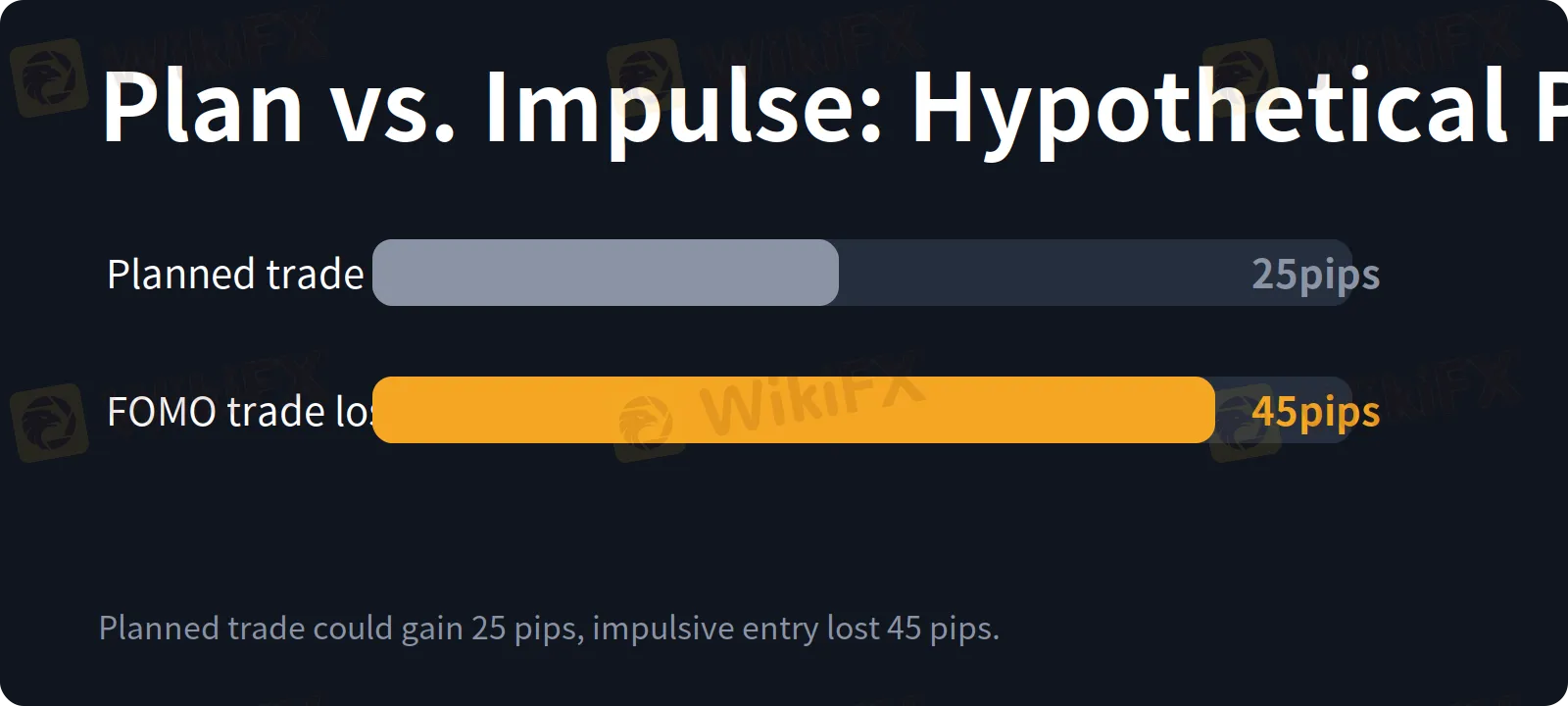
Scenario is hypothetical and not based on a real trade.
Observing Your Own FOMO Patterns
The first step toward managing FOMO is noticing that it is happening. One simple tool is a trading journal, but used in a specific way. Before you place any trade, jot down: what caught your attention? How do you feel, physically and emotionally? Does this entry match your predefined rules? After the trade (or after deciding not to trade), review those notes.
- Keep a notebook with three columns: date, your state of mind before the trade, and a rating from 0 to 10 of how rushed you felt.
- Over weeks, look for clusters: do you rate the urge highest when the market is moving fast? Thats your FOMO fingerprint.
- Ask yourself: did the market speed influence your decision? When you acted impulsively, what story were you telling yourself?
By learning to spot these patterns, you build self-awareness. Many traders discover that fast-moving markets are their biggest trigger.
FOMO is a natural brain response to perceived scarcity. Fast forex moves amplify that response by creating urgency. By studying the science behind it and observing your own reaction patterns, you build the self-awareness that is the bedrock of sound trading psychology.
ڈس کلیمر:
یہ مضمون صرف مصنف کی ذاتی رائے پر مبنی ہے، یہ پلیٹ فارم کی سرمایہ کاری کی مشورہ نہیں ہے۔ پلیٹ فارم مضمون کی معلومات کی درستگی، مکملیت اور بروقت ہونے کی کوئی ضمانت نہیں دیتا، اور مضمون کی معلومات پر اعتماد یا استعمال سے ہونے والے کسی بھی نقصان کی ذمہ داری قبول نہیں کرتا۔
